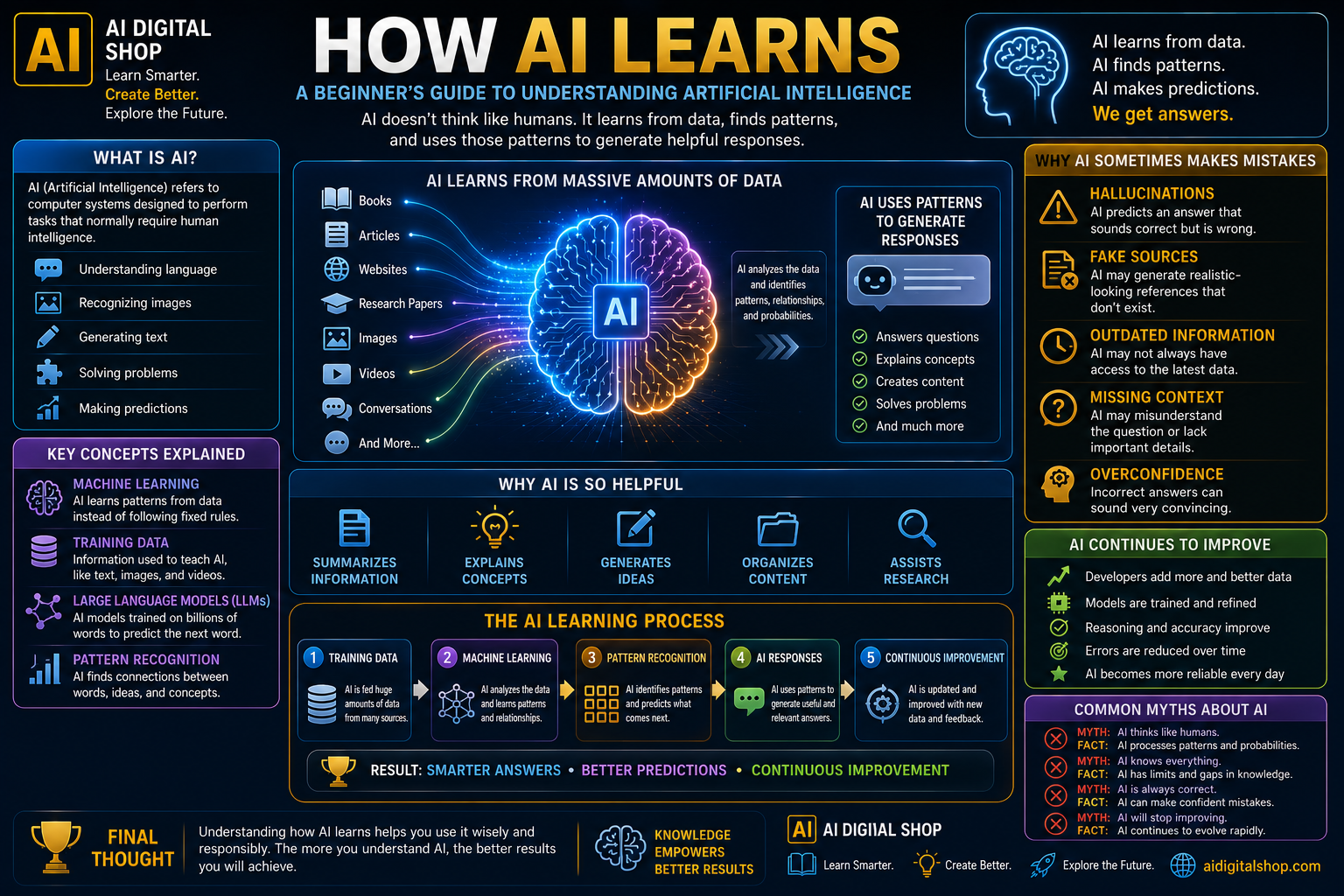
How AI Learns
A Beginner’s Guide to Understanding Artificial Intelligence
Introduction
Artificial intelligence is becoming part of everyday life.
People use AI to:
- Ask questions
- Generate content
- Create images
- Research topics
- Solve problems
But have you ever wondered:
How does AI actually learn?
Unlike humans, AI does not attend school, read books, or gain life experience.
Instead, AI learns through a process called training.
Understanding this process helps explain both the strengths and weaknesses of modern AI systems.
What Is Artificial Intelligence?
Artificial intelligence refers to computer systems designed to perform tasks that normally require human intelligence.
Examples include:
- Understanding language
- Recognizing images
- Generating text
- Solving problems
- Making predictions
Modern AI systems are built using advanced machine learning techniques.
What Is Machine Learning?
Machine learning is one of the core technologies behind AI.
Instead of following fixed instructions, machine learning systems learn patterns from data.
Think of it like this:
Humans learn from experience.
AI learns from data.
What Is Training Data?
Training data is the information used to teach AI systems.
This may include:
- Books
- Articles
- Websites
- Research papers
- Public information
- Images
- Videos
During training, AI analyzes enormous amounts of information to identify patterns.
What Is a Large Language Model?
Many popular AI systems are known as:
Large Language Models (LLMs)
These models are trained on massive amounts of text.
Their goal is to predict what words are most likely to come next.
Surprisingly, this simple idea creates powerful capabilities.
How AI Learns Patterns
Imagine showing an AI millions of examples of:
- Questions and answers
- Conversations
- Articles
- Stories
Over time, the AI learns relationships between words, concepts, and ideas.
It becomes increasingly effective at predicting useful responses.
Does AI Understand Information?
This is one of the most misunderstood aspects of AI.
AI does not understand information in the same way humans do.
Instead, it identifies patterns and probabilities.
This distinction explains many AI strengths—and many AI mistakes.
Why AI Can Be So Helpful
AI excels at:
Summarizing Information
Explaining Concepts
Generating Ideas
Organizing Content
Assisting Research
Because it has learned patterns from enormous amounts of data.
Why AI Sometimes Makes Mistakes
Understanding AI training helps explain:
Hallucinations
AI predicts an answer that sounds correct but is actually wrong.
Fake Sources
AI generates realistic-looking references that may not exist.
Outdated Information
AI may not always have access to current information.
Missing Context
Questions sometimes lack the information needed for accurate answers.
Can AI Continue Learning?
Some AI systems can be updated and improved over time.
Developers continually:
- Improve models
- Add training data
- Enhance reasoning
- Reduce errors
This is why modern AI systems are significantly better than earlier versions.
The Future of AI Learning
Future AI systems will likely become:
More Accurate
More Reliable
Better at Verification
Better at Understanding Context
However, human oversight will remain important.
Common Myths About AI
Myth #1
AI thinks like humans.
False.
AI processes patterns.
Myth #2
AI knows everything.
False.
AI can still make mistakes.
Myth #3
AI is always correct.
False.
Verification remains essential.
Myth #4
AI will stop improving.
False.
Development continues rapidly.
Final Thoughts
Understanding how AI learns makes it easier to use AI responsibly.
The more you understand:
- Training data
- Machine learning
- Language models
- AI limitations
the more effectively you can use artificial intelligence.
Knowledge reduces confusion and improves results.
Key Takeaways
1. AI learns from data.
2. Machine learning identifies patterns.
3. Large language models predict language.
4. AI does not think like humans.
5. AI can make mistakes.
6. Understanding AI improves your results.
Related Articles
- Can You Trust AI Answers?
- What Is an AI Hallucination?
- Why AI Invents Sources
- The Future of AI Accuracy
- Will AI Replace Google Search?
Learn Smarter. Create Better. Explore the Future.
📚 About the Publisher
Solvberg Publishing creates practical resources that help entrepreneurs, creators, educators, and lifelong learners succeed in the digital age.
Our growing library includes AI guides, business resources, children’s books, digital publishing tools, and educational content designed to inform, inspire, and empower.
Whether you’re building an online business, exploring artificial intelligence, or discovering new stories with your family, our goal is simple:
Create content that makes a difference.