The Future of AI Accuracy
Will Artificial Intelligence Ever Be 100% Correct?
Introduction
Artificial intelligence has improved dramatically in recent years.
Modern AI systems can:
- Write articles
- Analyze information
- Generate images
- Explain complex concepts
- Assist with research
- Help solve problems
Yet one important question remains:
Will AI ever become 100% accurate?
It’s a question asked by businesses, students, researchers, and everyday users.
Understanding the future of AI accuracy helps us understand where the technology is heading—and where human judgment will still matter.

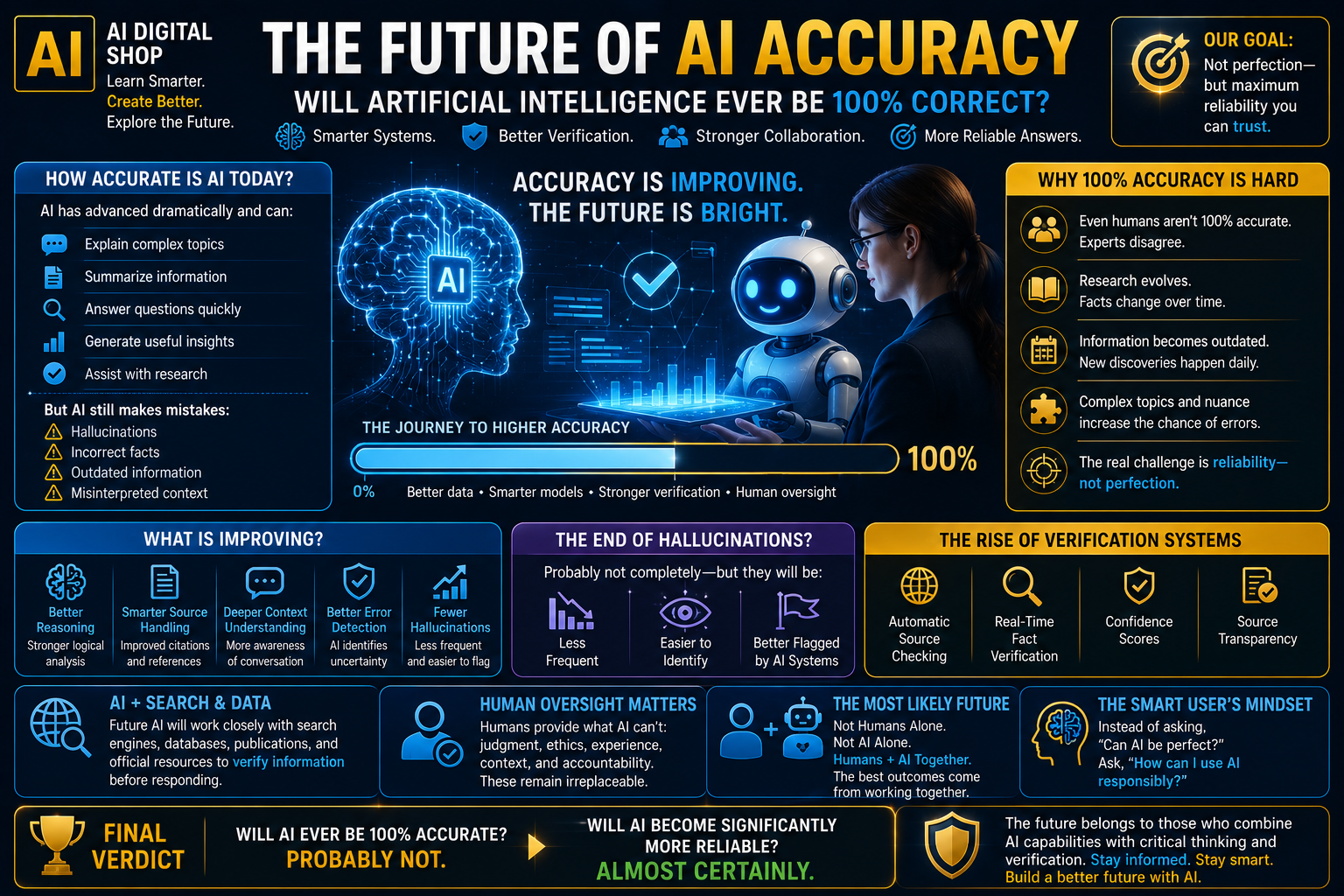
How Accurate Is AI Today?
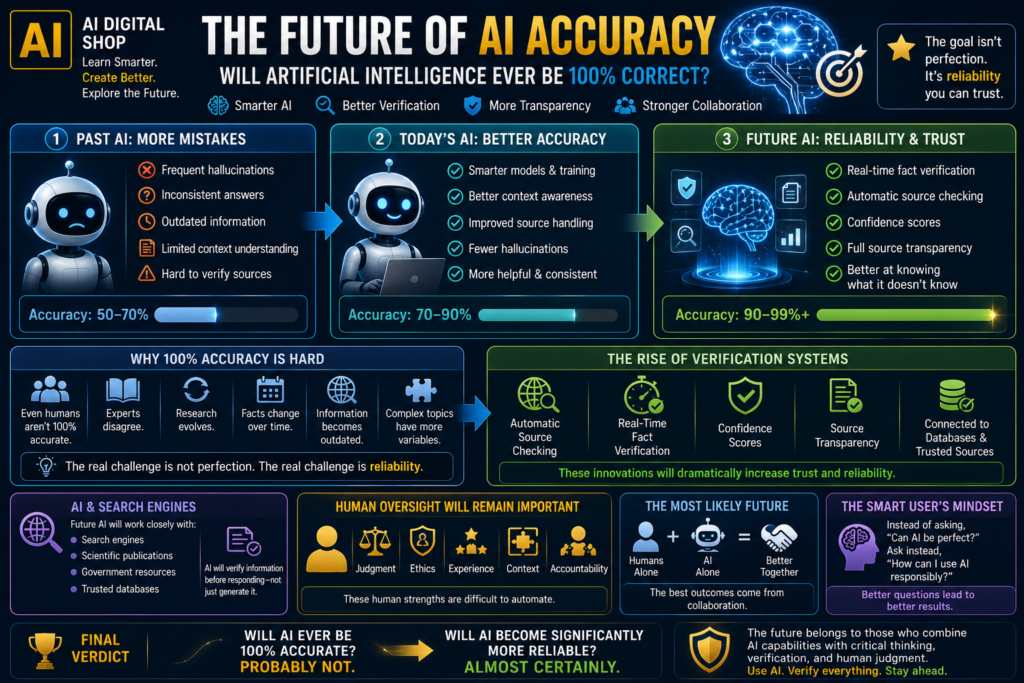
Compared to earlier systems, modern AI is remarkably capable.
Many AI tools can:
- Explain difficult topics
- Summarize large amounts of information
- Answer questions quickly
- Generate useful insights
However, even advanced systems still make mistakes.
These mistakes may include:
- Hallucinations
- Incorrect facts
- Outdated information
- Misinterpreted context
Why AI Still Makes Mistakes
AI systems do not think like humans.
Instead, they predict patterns.
Because of this:
Missing Information
Can create incorrect answers.
Ambiguous Questions
Can lead to misunderstandings.
Outdated Data
May affect accuracy.
Complex Topics
Increase the possibility of errors.
What Is Improving?
AI developers continue improving:
Reasoning
Better logical analysis.
Source Handling
Improved citation systems.
Context Understanding
More awareness of conversation history.
Error Detection
Better identification of uncertainty.
The End of Hallucinations?
Probably not completely.
Hallucinations may become:
- Less frequent
- Easier to identify
- Better flagged by AI systems
But eliminating them entirely may be extremely difficult.
Why 100% Accuracy Is Hard
Even humans are not 100% accurate.
Experts disagree.
Research evolves.
Facts change.
Information becomes outdated.
The real challenge is not perfection.
The real challenge is reliability.
The Rise of Verification Systems
Future AI systems may include:
Automatic Source Checking
Real-Time Fact Verification
Confidence Scores
Source Transparency
These improvements could significantly increase trustworthiness.
AI and Search Engines
Future AI may work closely with:
- Search engines
- Databases
- Scientific publications
- Government resources
Instead of generating answers on its own, AI may increasingly verify information before responding.
Human Oversight Will Remain Important
Even as AI improves, humans provide:
- Judgment
- Ethics
- Experience
- Context
- Accountability
These remain difficult to automate completely.
What the Future May Look Like
The most likely future is not:
Humans Alone
or
AI Alone
Instead:
Humans + AI Working Together
This combination often produces the best outcomes.
The Smart User’s Mindset
Instead of asking:
“Can AI be perfect?”
Ask:
“How can I use AI responsibly?”
This shift in thinking creates better results.
Final Verdict
Will AI ever become 100% accurate?
Probably not.
Will it become significantly more reliable?
Almost certainly.
The future belongs to people who learn how to combine AI capabilities with critical thinking and verification.
Key Takeaways
1. AI is improving rapidly.
2. Hallucinations will likely decrease.
3. Verification will remain important.
4. Human judgment still matters.
5. Future AI will become more reliable.
6. AI and humans work best together.
Related Articles
- Can You Trust AI Answers?
- What Is an AI Hallucination?
- How to Fact-Check AI Answers
- Why AI Invents Sources
- Can AI Replace Human Experts?
Learn Smarter. Create Better. Explore the Future.
📚 About the Publisher
Solvberg Publishing creates practical resources that help entrepreneurs, creators, educators, and lifelong learners succeed in the digital age.
Our growing library includes AI guides, business resources, children’s books, digital publishing tools, and educational content designed to inform, inspire, and empower.
Whether you’re building an online business, exploring artificial intelligence, or discovering new stories with your family, our goal is simple:
Create content that makes a difference.