
Why AI Invents Sources
Understanding One of AI’s Most Common Mistakes
Introduction
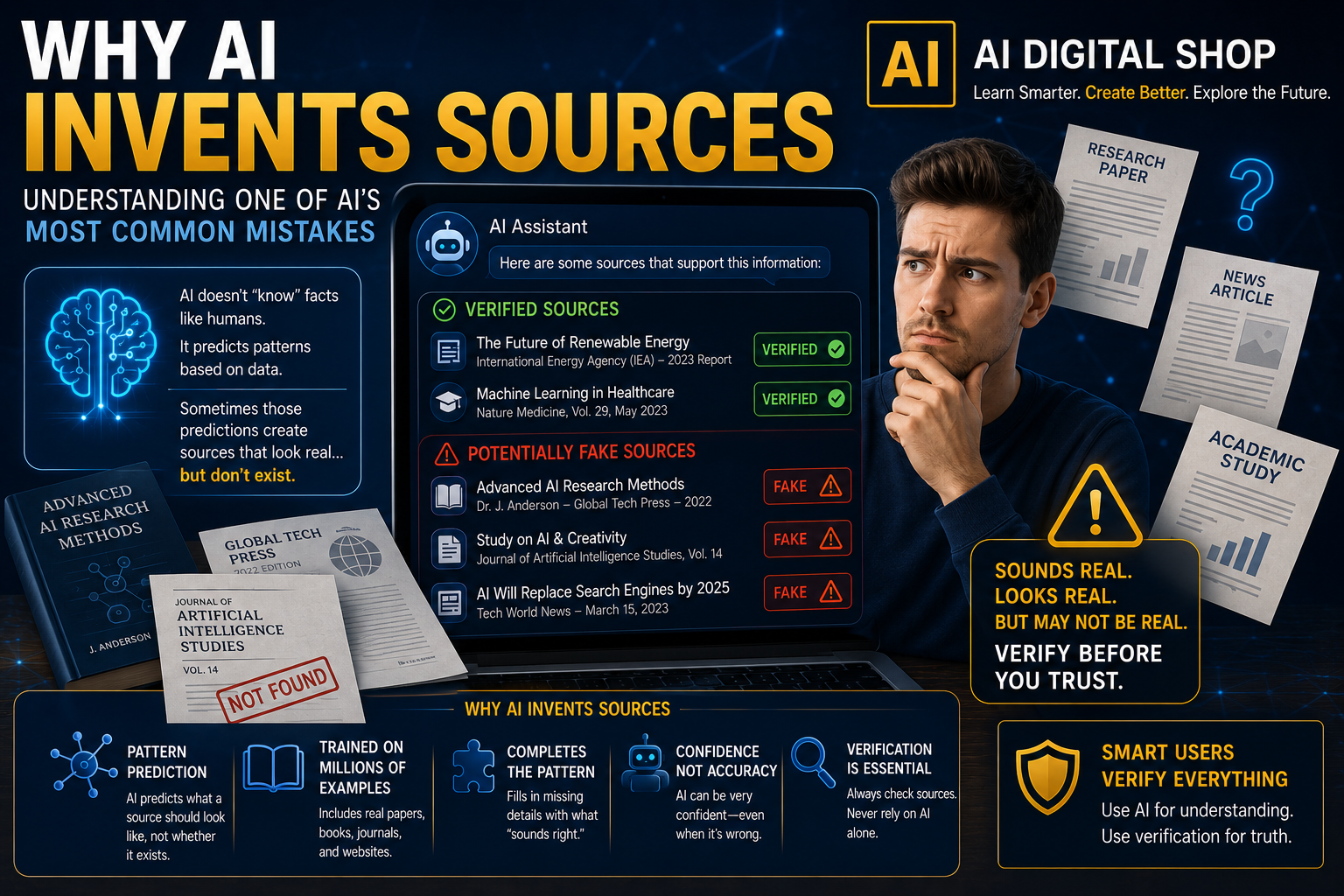
One of the most surprising mistakes artificial intelligence can make is inventing sources that do not actually exist.
The AI may confidently provide:
- Research papers
- Books
- Academic studies
- News articles
- Expert quotes
The problem?
Sometimes those sources are completely fabricated.
This can be confusing because the references often look genuine.
They may include:
- Author names
- Publication dates
- Journal titles
- Detailed descriptions
Everything appears real.
Until you try to find the source.
Understanding why this happens is one of the most important lessons for anyone using AI regularly.
Does AI Intentionally Create Fake Sources?
No.
Artificial intelligence is not trying to deceive anyone.
AI does not possess intentions, beliefs, or motives.
Instead, it predicts language patterns.
Sometimes those predictions create references that sound realistic but do not actually exist.
This is a form of AI hallucination.
How AI Generates Answers
To understand the problem, it helps to understand how AI works.
AI systems do not search their memory for facts like humans do.
Instead, they generate responses based on patterns learned during training.
When asked for a source, the AI predicts what a source should look like.
Most of the time, this works well.
Sometimes it produces something that only appears to be real.
Why Fake Sources Look So Convincing
AI has seen millions of examples of:
- Research papers
- Academic citations
- News references
- Books
- Reports
As a result, it becomes very good at reproducing the format.
A fake source often contains:
Realistic Titles
Realistic Author Names
Realistic Publication Dates
Realistic Journal Names
Realistic Formatting
The source may look perfect.
That does not mean it exists.
Common Types of Invented Sources
Academic Studies
One of the most common hallucinations.
AI creates studies that sound completely plausible.
Research Reports
Detailed reports from organizations that never published them.
Expert Quotes
Statements attributed to experts who never said them.
Books
Books that do not exist.
News Articles
Articles that were never written.
Why This Matters
In casual conversations, a fake source may not matter much.
In professional situations, it can become a serious problem.
Examples include:
- Academic work
- Business reports
- Legal research
- Medical information
- Financial decisions
Verification becomes essential.
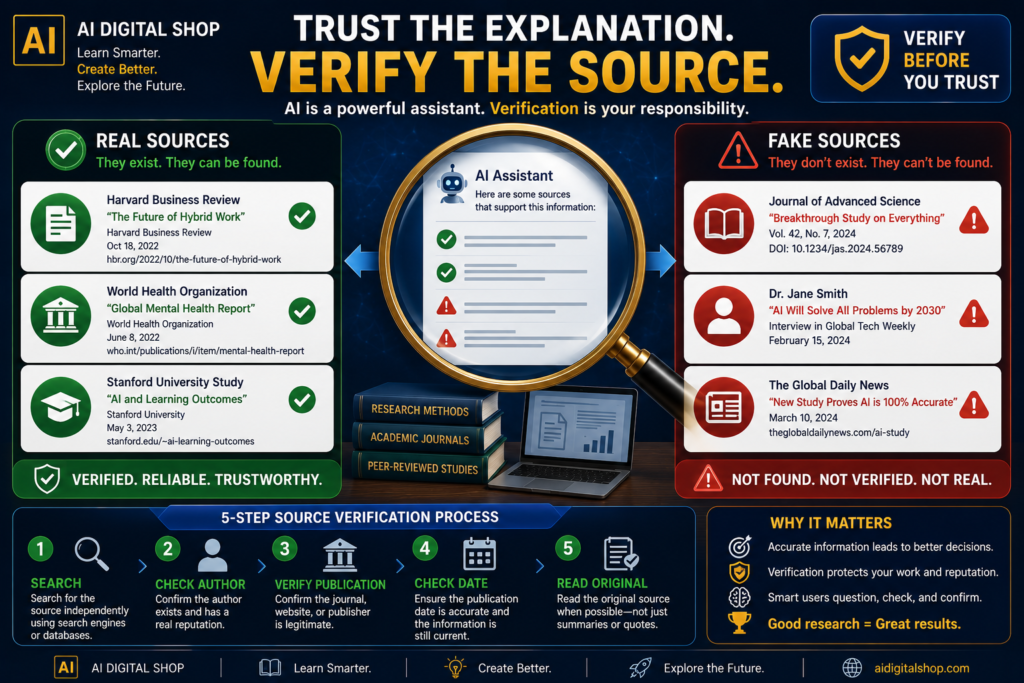
How to Spot a Fake Source
Certain warning signs should trigger caution.
The Source Cannot Be Found
Search for it.
If it doesn’t exist, investigate further.
No Publisher Information
Legitimate sources usually have a clear publisher.
No Author Information
Missing authors may indicate a problem.
Unusual Journal Names
Some hallucinated journals sound real but are fictional.
Broken Links
AI may occasionally reference URLs that do not exist.
How to Verify Sources
Follow a simple process.
Step 1
Search for the source independently.
Step 2
Confirm the author exists.
Step 3
Verify the publication.
Step 4
Check the publication date.
Step 5
Read the original source whenever possible.
Why Search Engines Still Matter
This is one reason search engines remain valuable.
Google and other search engines can help verify:
- Sources
- Authors
- Publications
- Research papers
AI and search engines work best together.
Will This Problem Improve?
Yes.
AI systems continue improving.
Newer models are becoming better at:
- Citation handling
- Source identification
- Verification processes
However, no current AI system is perfect.
Users should continue verifying important references.
The Smart User Approach
The smartest AI users follow a simple rule:
Trust the explanation.
Verify the source.
This approach combines the strengths of AI with the reliability of independent verification.
Final Thoughts
Artificial intelligence can be a powerful research assistant.
But it is not a substitute for verification.
Understanding why AI invents sources helps you:
- Avoid mistakes
- Improve accuracy
- Use AI more effectively
- Build better research habits
Knowledge of this limitation makes you a stronger and more confident AI user.
Key Takeaways
1. AI does not intentionally create fake sources.
2. AI predicts patterns rather than recalling facts.
3. Invented sources are a form of hallucination.
4. Fake citations often look convincing.
5. Verification is essential.
6. Search engines remain valuable for source checking.
Related Articles
- Can You Trust AI Answers?
- What Is an AI Hallucination?
- How to Fact-Check AI Answers
- AI vs Google Search
- 25 Common AI Mistakes Beginners Make
Learn Smarter. Create Better. Explore the Future.
📚 About the Publisher
Solvberg Publishing creates practical resources that help entrepreneurs, creators, educators, and lifelong learners succeed in the digital age.
Our growing library includes AI guides, business resources, children’s books, digital publishing tools, and educational content designed to inform, inspire, and empower.
Whether you’re building an online business, exploring artificial intelligence, or discovering new stories with your family, our goal is simple:
Create content that makes a difference.