

AI for Everyday Life: How Artificial Intelligence Can Help You Learn, Work, Create, and Save Time
Introduction
Artificial intelligence is no longer a technology reserved for scientists, programmers, or large corporations. Here is how AI can improve your daily life.
Today, AI is becoming part of everyday life.
Millions of people use AI tools to:
- Learn new skills
- Save time
- Improve productivity
- Generate ideas
- Organize projects
- Research information
- Create content
- Solve everyday problems
The rapid growth of AI has created both excitement and confusion.
Many people still wonder:
How can AI actually help me in real life?
The answer may surprise you.
Artificial intelligence is already helping students, employees, business owners, freelancers, creators, and retirees become more productive and efficient.
The key is understanding how to use AI wisely.
What Is AI?
Artificial intelligence refers to computer systems that can perform tasks normally requiring human intelligence.
These tasks include:
- Understanding language
- Recognizing patterns
- Solving problems
- Analyzing information
- Generating content
Modern AI tools can communicate in plain language, making them accessible to almost everyone.
You no longer need technical expertise to benefit from AI.
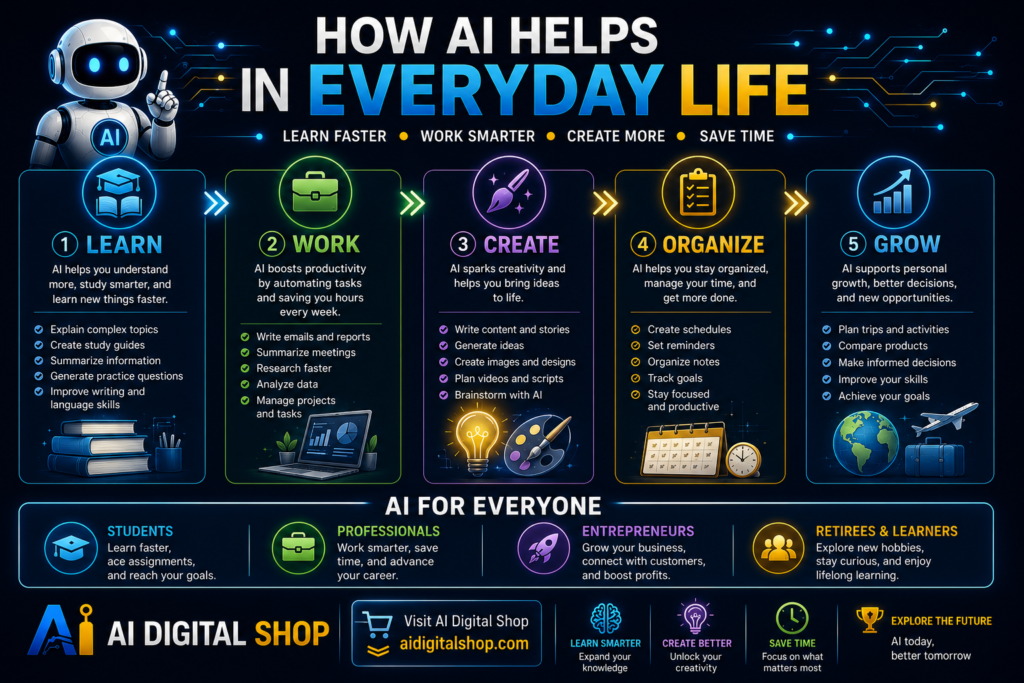
AI for Learning: Study Smarter, Not Harder
One of the most powerful uses of AI is education.
Students and lifelong learners can use AI to:
Explain Difficult Concepts
Complex topics can be broken down into simpler explanations.
Create Study Guides
AI can summarize long articles, chapters, and reports.
Generate Practice Questions
Students can test their knowledge and identify weak areas.
Improve Writing Skills
AI can help organize ideas and improve clarity.
Learn New Subjects Faster
Whether learning a language, history, science, or technology, AI can act as a personal study assistant.
The result is more efficient learning and better understanding.
AI for Work: Work Smarter, Not Harder
Professionals are increasingly using AI to improve productivity.
AI can help with:
Email Drafting
Creating professional responses quickly.
Meeting Summaries
Extracting key points from discussions.
Research
Gathering information faster.
Content Creation
Generating drafts, outlines, and ideas.
Data Analysis
Identifying trends and insights.
By automating repetitive tasks, AI allows people to focus on higher-value work.
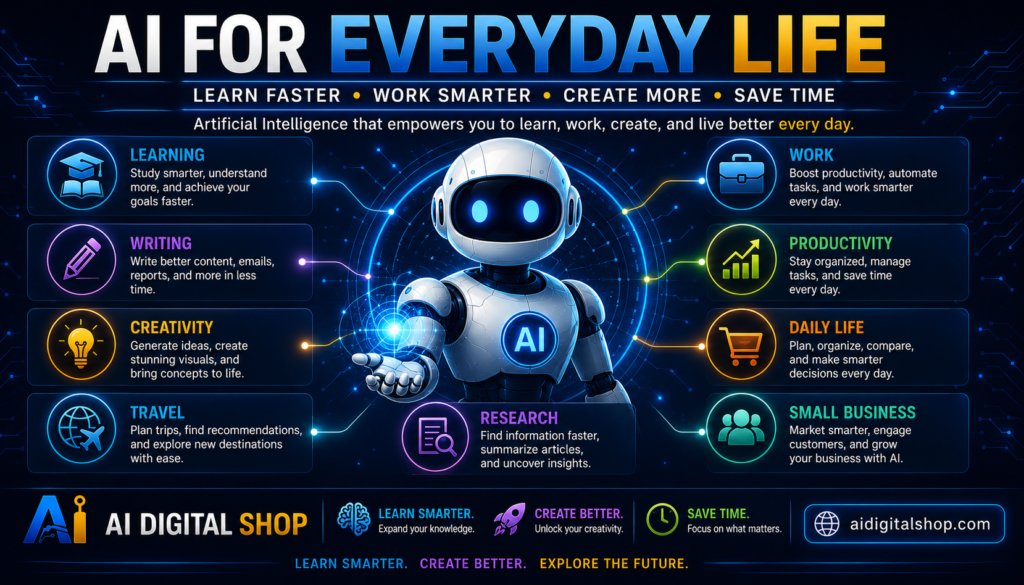
AI for Creativity
Many people assume AI is only useful for technical tasks.
In reality, AI can be an excellent creative partner.
AI can assist with:
Writing
Blog posts, stories, articles, and outlines.
Design
Images, graphics, and visual concepts.
Brainstorming
Generating ideas when inspiration is lacking.
Video Planning
Scripts, outlines, and content strategies.
Marketing
Headlines, social posts, and campaign ideas.
AI does not replace creativity.
It helps unlock it.
AI for Research
Research that once required hours can often be completed much faster.
AI can help users:
- Summarize information
- Compare viewpoints
- Organize notes
- Identify key themes
- Generate follow-up questions
However, important information should always be verified using trusted sources.
AI is a research assistant, not a replacement for critical thinking.
AI for Daily Tasks
Artificial Intelligence is increasingly useful for everyday life.
Examples include:
Trip Planning
Building travel itineraries and suggestions.
Meal Planning
Generating recipes and grocery lists.
Personal Organization
Creating schedules and task lists.
Shopping Research
Comparing products and features.
Decision Support
Helping evaluate options and alternatives.
Even simple daily tasks can become easier with the right AI tools.
AI for Small Business Owners
Small businesses often operate with limited resources.
AI can help by acting as a virtual assistant.
Business owners can use AI for:
Marketing
Generating content and campaigns.
Customer Service
Drafting responses and FAQs.
Product Descriptions
Creating listings faster.
SEO Research
Identifying keywords and content opportunities.
Social Media
Generating post ideas and content calendars.
For many small businesses, AI provides capabilities previously available only to larger companies.
AI for Retirees and Lifelong Learners
AI is not just for younger generations.
Retirees can benefit from AI by:
- Learning new hobbies
- Researching travel destinations
- Organizing personal projects
- Exploring health information
- Creating family histories
- Writing memoirs and stories
AI can become a valuable companion for curiosity and lifelong learning.
Common Mistakes to Avoid
While AI is powerful, it is not perfect.
Avoid these common mistakes:
Blind Trust
Always verify important information.
Sharing Sensitive Data
Protect personal and financial information.
Ignoring Sources
Check where information originates.
Replacing Human Judgment
AI should support decisions, not make them.
Expecting Perfection
AI can make mistakes and occasionally provide inaccurate answers.
Understanding these limitations helps users achieve better results.
The Future of AI in Everyday Life
AI is becoming more accessible every year.
Future tools will likely become:
- More accurate
- More personalized
- More useful
- Easier to use
As adoption grows, AI may become as common as search engines, smartphones, and email.
Those who learn how to use AI effectively today may gain significant advantages in the future.
Final Thoughts
Artificial intelligence is not just a technology trend.
It is rapidly becoming a practical tool for everyday life.
Whether you want to:
- Learn faster
- Work smarter
- Create more effectively
- Save time
- Improve productivity
AI offers opportunities that were unimaginable only a few years ago.
The goal is not to let AI think for you.
The goal is to use AI as a tool that helps you achieve more while maintaining your own judgment, creativity, and critical thinking.
Key Takeaways
1. AI can help with learning, work, creativity, and daily tasks.
2. AI saves time and improves productivity.
3. AI is useful for students, professionals, business owners, and retirees.
4. AI works best when combined with human judgment.
5. Verification remains important.
6. The future of AI will likely become even more integrated into everyday life.
Related Articles
- AI for Learning: Study Smarter, Not Harder
- AI for Work: Work Smarter, Not Harder
- AI Tools That Boost Your Productivity
- How AI Learns
- Can You Trust AI Answers?
Learn Smarter. Create Better. Explore the Future.
📚 About the Publisher
Solvberg Publishing creates practical resources that help entrepreneurs, creators, educators, and lifelong learners succeed in the digital age.
Our growing library includes AI guides, business resources, children’s books, digital publishing tools, and educational content designed to inform, inspire, and empower.
Whether you’re building an online business, exploring artificial intelligence, or discovering new stories with your family, our goal is simple:
Create content that makes a difference.