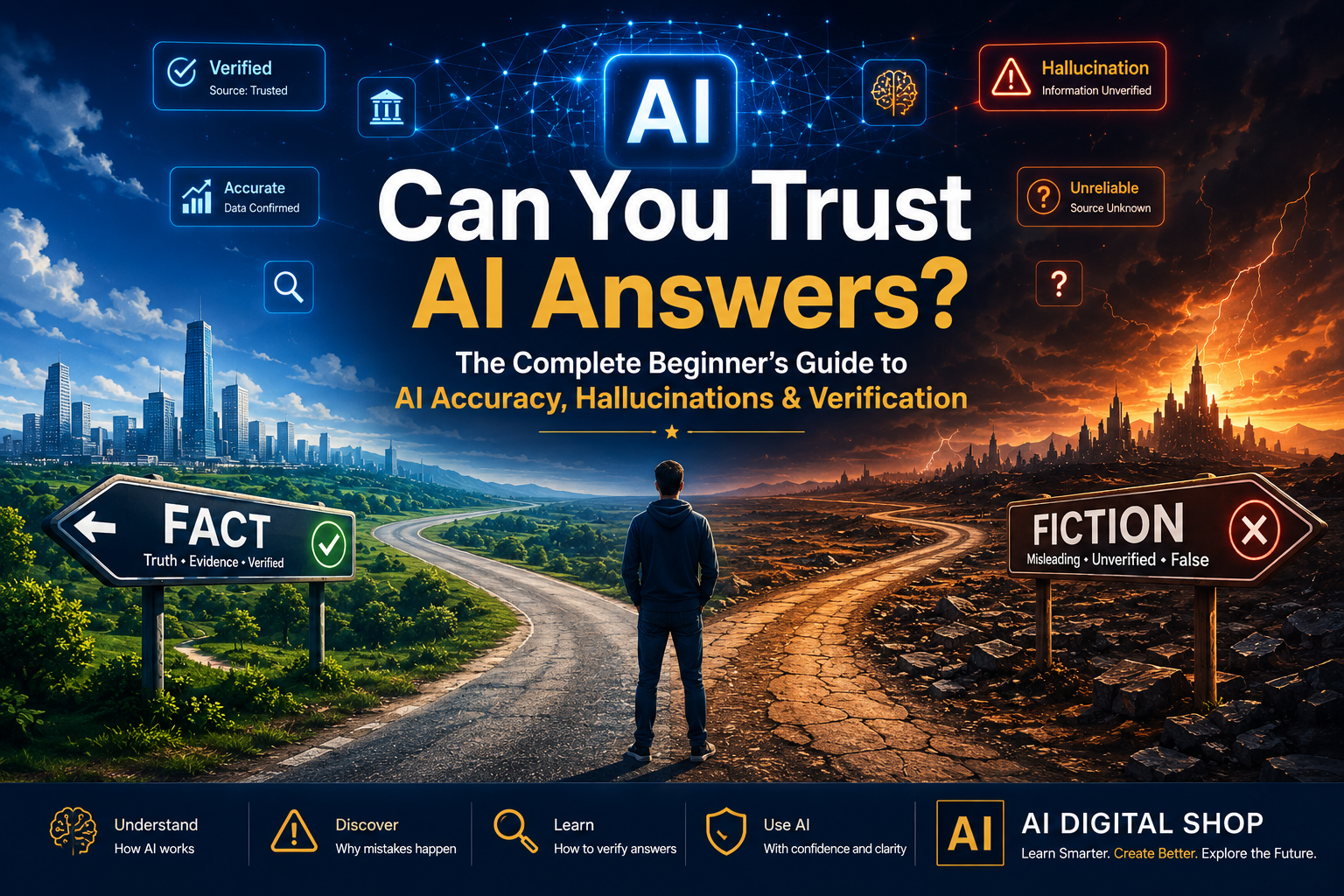
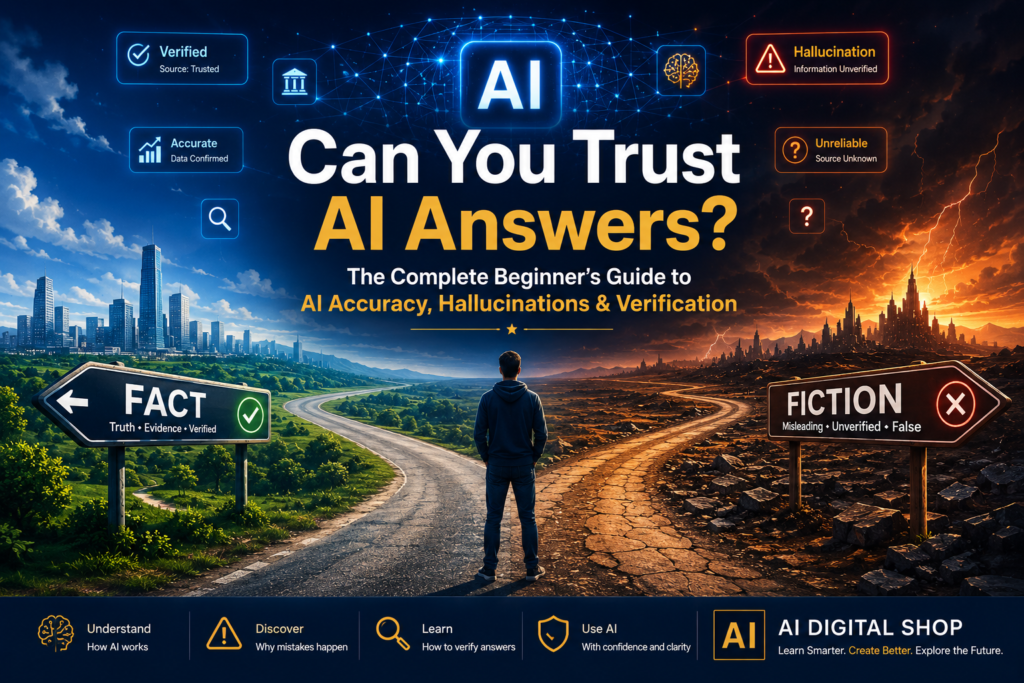
Can You Trust AI Answers?
The Complete Beginner’s Guide to AI Accuracy, Hallucinations & Verification
Introduction
Artificial intelligence has quickly become one of the most powerful tools available to businesses, creators, students, and everyday users.
Millions of people now use AI to:
- Write content
- Research information
- Generate ideas
- Learn new skills
- Create images
- Improve productivity
But one question continues to appear over and over again:
Can you actually trust AI answers?
The answer is not as simple as “yes” or “no.”
AI can be remarkably helpful, surprisingly intelligent, and incredibly efficient.
It can also be confidently wrong.
Understanding when to trust AI—and when to verify its answers—is one of the most important skills any AI user can develop.
This guide will help you understand exactly how AI works, why mistakes happen, and how to use AI responsibly and effectively.
Understanding How AI Generates Answers
One of the biggest misconceptions about AI is that it “knows” things in the same way humans do.
It doesn’t.
Modern AI systems analyze patterns learned from enormous amounts of information.
When you ask a question, the AI predicts what response is most likely to follow based on those patterns.
Think of it like an incredibly advanced prediction engine rather than a human expert.
This distinction is important because it explains why AI can produce brilliant answers one moment and surprisingly inaccurate answers the next.
Why AI Can Be So Helpful
Despite its limitations, AI offers tremendous benefits.
It can:
- Summarize complex topics
- Generate ideas quickly
- Explain difficult concepts
- Organize information
- Draft content
- Assist with research
- Improve productivity
For many users, AI serves as an assistant that can dramatically reduce the time required to complete everyday tasks.
Used properly, AI can become one of the most valuable productivity tools available.
What Is an AI Hallucination?
One of the most discussed weaknesses of AI is something known as a hallucination.
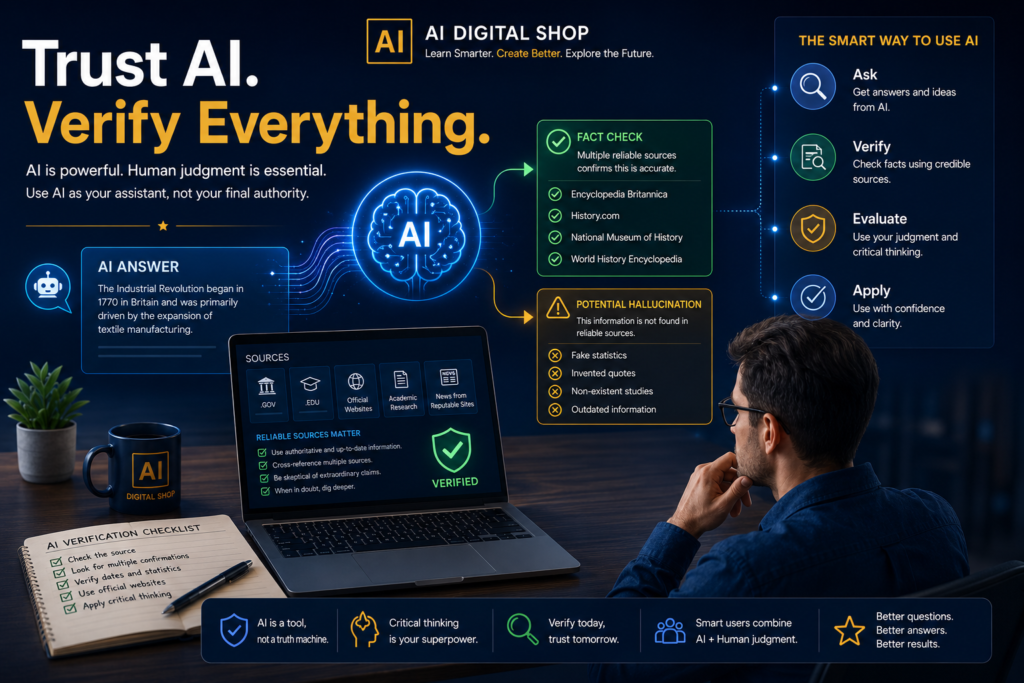
An AI hallucination occurs when the system generates information that sounds convincing but is actually incorrect.
Examples may include:
- Invented facts
- Non-existent sources
- Incorrect statistics
- Fake quotations
- Imaginary events
- Fabricated references
The challenge is that hallucinations often appear highly believable.
In some cases, they can be difficult to detect without independent Verification.
Why Do Hallucinations Happen?
AI systems are designed to generate responses.
When they encounter uncertainty, they sometimes attempt to fill gaps using patterns rather than verified facts.
The result can be information that sounds reasonable but is inaccurate.
This is not dishonesty.
The AI is not intentionally misleading anyone.
It is simply generating the most statistically likely response based on its training.
Situations Where AI Is Usually Reliable
AI tends to perform well when:
Explaining General Concepts
Examples include:
- What is machine learning?
- How does email marketing work?
- What is SEO?
Brainstorming Ideas
AI can be excellent for:
- Blog topics
- Business ideas
- Marketing campaigns
- Content outlines
Improving Productivity
Tasks such as:
- Writing drafts
- Creating summaries
- Organizing information
They are often well-suited for AI assistance.
Situations Where Verification Is Essential
Certain situations require extra caution.
Always verify:
Medical Information
Never rely exclusively on AI for health decisions.
Consult qualified healthcare professionals.
Legal Information
Laws vary by jurisdiction and change frequently.
Professional legal advice is essential.
Financial Decisions
Investment, tax, and financial planning decisions should always be independently verified.
Breaking News
News events develop rapidly.
AI may not always have access to the most current information.
How to Verify AI Answers
Learning to verify AI output is one of the most valuable skills you can develop.
Consider the following process:
Step 1: Ask Follow-Up Questions
Challenge the answer.
Ask:
- How do you know this?
- Can you provide sources?
- What evidence supports this claim?
Step 2: Cross-Reference Information
Compare answers with:
- Official websites
- Government sources
- Industry publications
- Academic research
Step 3: Look for Consensus
If multiple reputable sources agree, confidence generally increases.
Step 4: Apply Common Sense
If something sounds too good to be true, it often is.
Critical thinking remains essential.
The Human Advantage
AI can process information quickly.
Humans bring:
- Judgment
- Experience
- Context
- Creativity
- Ethics
- Common sense
The most effective users combine both.
Rather than replacing human thinking, AI works best when it enhances human capabilities.
Should Beginners Be Afraid of AI Mistakes?
No.
Every technology has limitations.
Search engines return inaccurate information.
Humans make mistakes.
Books contain errors.
The key is understanding those limitations.
When used responsibly, AI remains incredibly valuable despite occasional inaccuracies.
Practical Rules for Using AI Safely
Rule #1
Use AI as a starting point, not the final authority.
Rule #2
Verify important information.
Rule #3
Protect personal and sensitive data.
Rule #4
Develop critical thinking skills.
Rule #5
Continue learning.
AI technology evolves rapidly.
The Future of AI Accuracy
AI systems continue improving every year.
Models are becoming:
- More accurate
- More capable
- More reliable
- Better at reasoning
However, perfection remains unlikely.
Human oversight will continue to play an important role for the foreseeable future.
Final Verdict: Can You Trust AI Answers?
Yes—but with conditions.
AI can be an extraordinary tool for learning, productivity, creativity, and research.
However, it should not be treated as an infallible source of truth.
The smartest approach is simple:
Trust AI enough to help you learn, but verify AI when the stakes matter.
When combined with critical thinking and responsible Verification, artificial intelligence becomes one of the most powerful tools available in the modern world.
Key Takeaways
✅ AI can be extremely useful.
✅ AI can make mistakes.
✅ Hallucinations are real.
✅ Verification is essential for important decisions.
✅ Human judgment remains valuable.
✅ The best results come from combining AI assistance with critical thinking.
Learn Smarter. Create Better. Explore the Future.
📚 About the Publisher
Solvberg Publishing creates practical resources that help entrepreneurs, creators, educators, and lifelong learners succeed in the digital age.
Our growing library includes AI guides, business resources, children’s books, digital publishing tools, and educational content designed to inform, inspire, and empower.
Whether you’re building an online business, exploring artificial intelligence, or discovering new stories with your family, our goal is simple:
Create content that makes a difference.