
How to Fact-Check AI Answers
A Simple Step-by-Step Guide for Beginners
Introduction
Artificial intelligence can be incredibly helpful. Here is how to fact-check AI Answers.
It can answer questions, explain concepts, generate ideas, summarize information, and improve productivity.
But there is one important reality every AI user must understand:
AI can make mistakes.
Sometimes those mistakes are obvious.
Sometimes they are surprisingly convincing.
That is why fact-checking AI answers is one of the most valuable skills you can develop.
The goal isn’t to distrust AI.
The goal is to use AI intelligently.
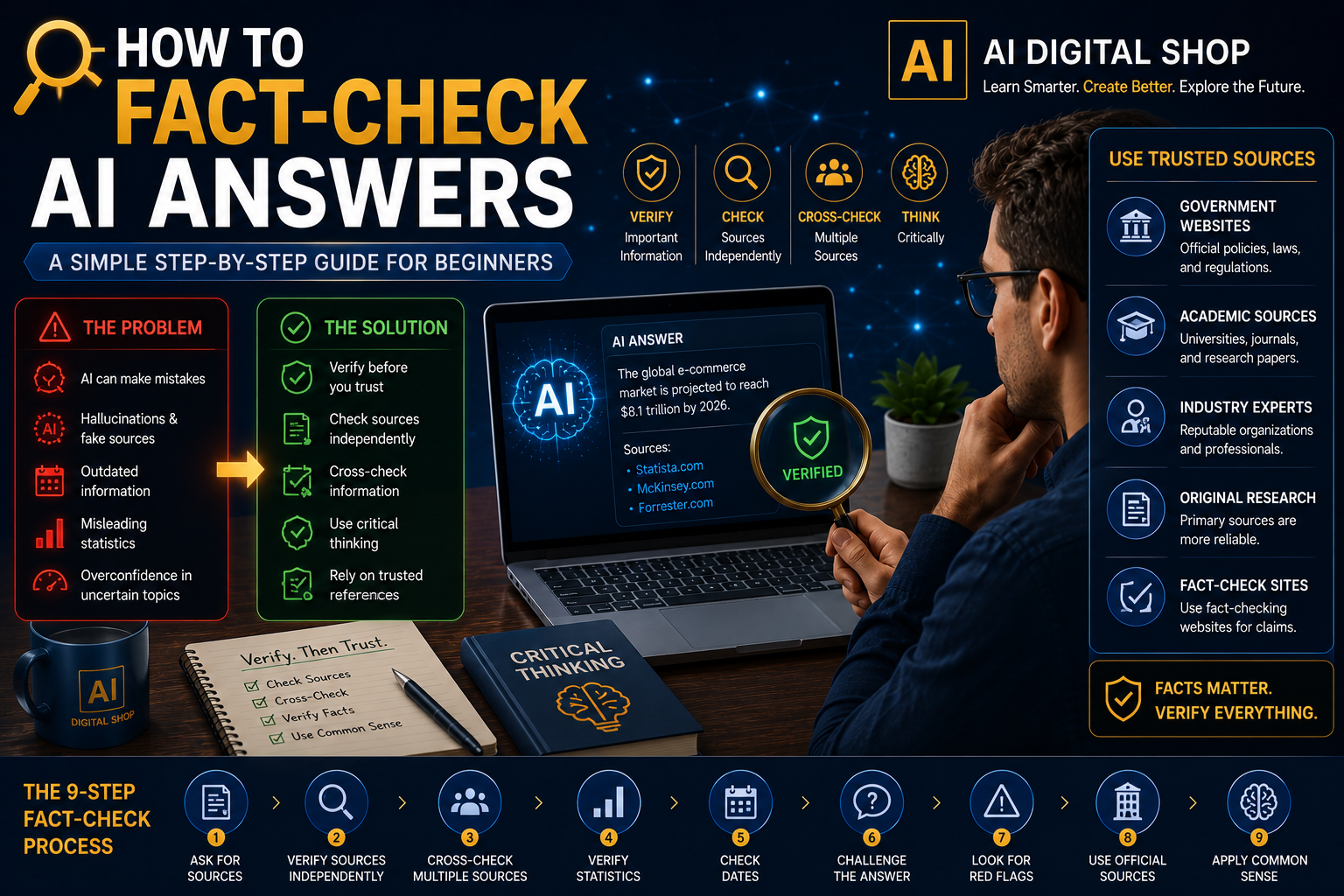
In this guide, you’ll learn a simple step-by-step process for verifying AI-generated information before relying on it.
Why Fact-Checking Matters
Artificial intelligence does not “know” information in the same way humans do.
Instead, AI predicts responses based on patterns found in enormous amounts of data.
Most of the time, this works extremely well.
Occasionally, it doesn’t.
This can lead to:
- Incorrect facts
- Fake statistics
- Invented sources
- Outdated information
- Misleading conclusions
Understanding how to verify information helps reduce these risks.
When Should You Verify AI Answers?
Not every response requires deep investigation.
For example:
Low-Risk Uses
- Brainstorming ideas
- Story writing
- Content outlines
- Creative projects
Verification may not be critical.
High-Risk Uses
Always verify:
- Medical information
- Financial information
- Legal information
- Scientific claims
- Academic research
- Business decisions
The higher the stakes, the more important verification becomes.
Step 1: Ask for Sources
Whenever AI provides important information, ask:
“What sources support this answer?”
Helpful follow-up questions:
- Where did this information come from?
- Can you provide references?
- Is this based on official sources?
Sources create a starting point for verification.
Step 2: Verify the Sources Independently
Never assume a source is real simply because AI mentions it.
Visit:
- Official websites
- Government resources
- Universities
- Academic databases
- Industry publications
Confirm the source actually exists.
Step 3: Cross-Check Multiple Sources
One source is rarely enough.
Look for confirmation from multiple trustworthy sources.
When independent sources agree, confidence increases significantly.
Step 4: Verify Statistics
Statistics are one of the most common areas where AI errors occur.
Whenever you see:
- Percentages
- Revenue figures
- Research numbers
- Survey results
Ask:
“Can this number be verified?”
Always locate the original source if possible.
Step 5: Check Dates
Information changes.
AI may reference:
- Old laws
- Old software features
- Old pricing
- Outdated regulations
Always verify:
Is this information current?
Recent information is usually more reliable.
Step 6: Challenge the Answer
Many users accept the first response.
Experienced users ask:
- Why?
- How?
- What evidence supports this?
- Is there another viewpoint?
Good questions often reveal weaknesses.
Step 7: Look for Red Flags
Certain warning signs should immediately trigger caution.
Red Flag #1
No source provided.
Red Flag #2
Extremely specific statistics without evidence.
Red Flag #3
Quotes that cannot be verified.
Red Flag #4
References to studies that don’t exist.
Red Flag #5
Overconfidence about uncertain topics.
Step 8: Use Official Sources Whenever Possible
Official sources are often the most reliable.
Examples include:
Government Websites
Policies, laws, regulations.
Universities
Research and academic information.
Professional Organizations
Industry standards and guidance.
Original Research
Whenever possible, review primary sources rather than summaries.
Step 9: Apply Common Sense
One of the best fact-checking tools is still human judgment.
Ask yourself:
Does this sound reasonable?
Does it match other information I’ve seen?
Is there evidence supporting the claim?
Critical thinking remains essential.
Common AI Fact-Checking Mistakes
Avoid these common errors:
❌ Trusting the first answer
❌ Ignoring sources
❌ Accepting statistics without verification
❌ Assuming confidence equals accuracy
❌ Skipping follow-up questions
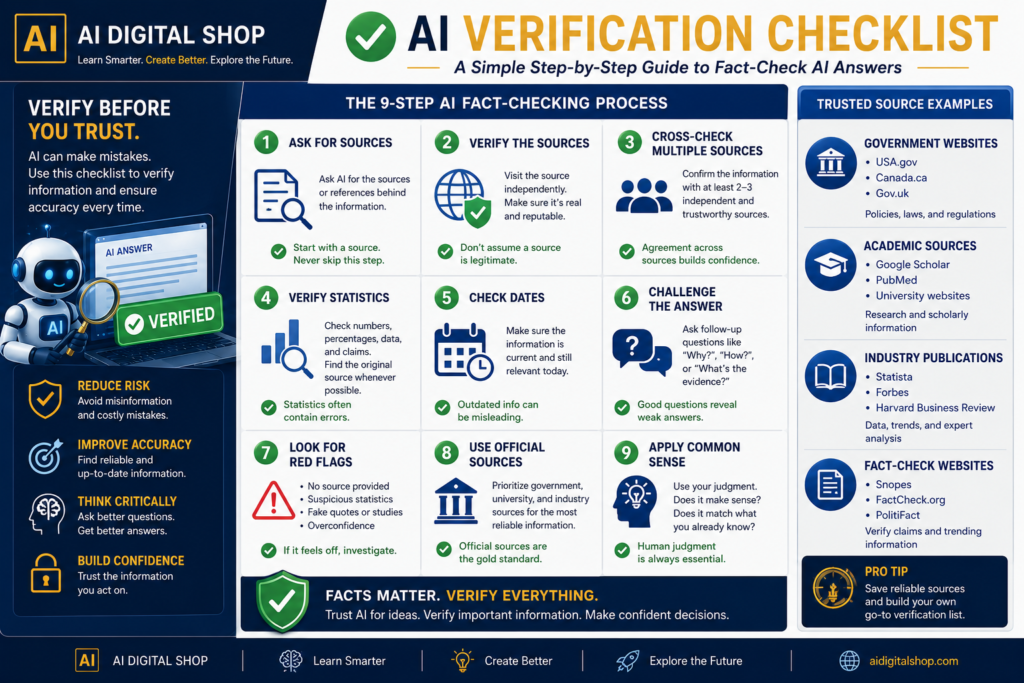
The AI Verification Checklist
Before trusting important information:
✅ Ask for sources
✅ Verify the sources
✅ Check multiple sources
✅ Confirm statistics
✅ Verify dates
✅ Look for red flags
✅ Apply common sense
The Future of AI Accuracy
Artificial intelligence continues improving.
Future systems will likely:
- Provide better citations
- Reduce hallucinations
- Improve reasoning
- Increase reliability
However, no technology is perfect.
Verification will remain valuable.
Final Thoughts on How To Fact-Check AI Answers
Artificial intelligence is one of the most powerful tools available today.
But responsible use requires verification.
The smartest users do not blindly trust AI.
They combine:
- AI assistance
- Independent verification
- Critical thinking
When used together, these create far better outcomes than either humans or AI working alone.
Key Takeaways
✅ AI can make mistakes.
✅ Fact-checking improves reliability.
✅ Sources matter.
✅ Statistics should be verified.
✅ Critical thinking remains essential.
✅ Trust AI—but verify important information.
Related Articles
- Can You Trust AI Answers?
- What Is an AI Hallucination?
- 25 Common AI Mistakes Beginners Make
- Why AI Invents Sources
- AI vs Google Search
Learn Smarter. Create Better. Explore the Future.
📚 About the Publisher
Solvberg Publishing creates practical resources that help entrepreneurs, creators, educators, and lifelong learners succeed in the digital age.
Our growing library includes AI guides, business resources, children’s books, digital publishing tools, and educational content designed to inform, inspire, and empower.
Whether you’re building an online business, exploring artificial intelligence, or discovering new stories with your family, our goal is simple:
Create content that makes a difference.