What Is an AI Hallucination?
Why Artificial Intelligence Sometimes Makes Things Up
Introduction
Artificial intelligence has become an incredibly useful tool for research, learning, productivity, content creation, and business.
Millions of people now use AI assistants every day.
But there is one strange phenomenon that continues to surprise both beginners and experienced users:
Artificial intelligence sometimes makes things up.
These mistakes are often called AI hallucinations.
The name may sound unusual, but it describes one of the most important limitations of modern AI systems.
Understanding AI hallucinations can help you become a smarter AI user, avoid costly mistakes, and learn when to verify information.
What Is an AI Hallucination?
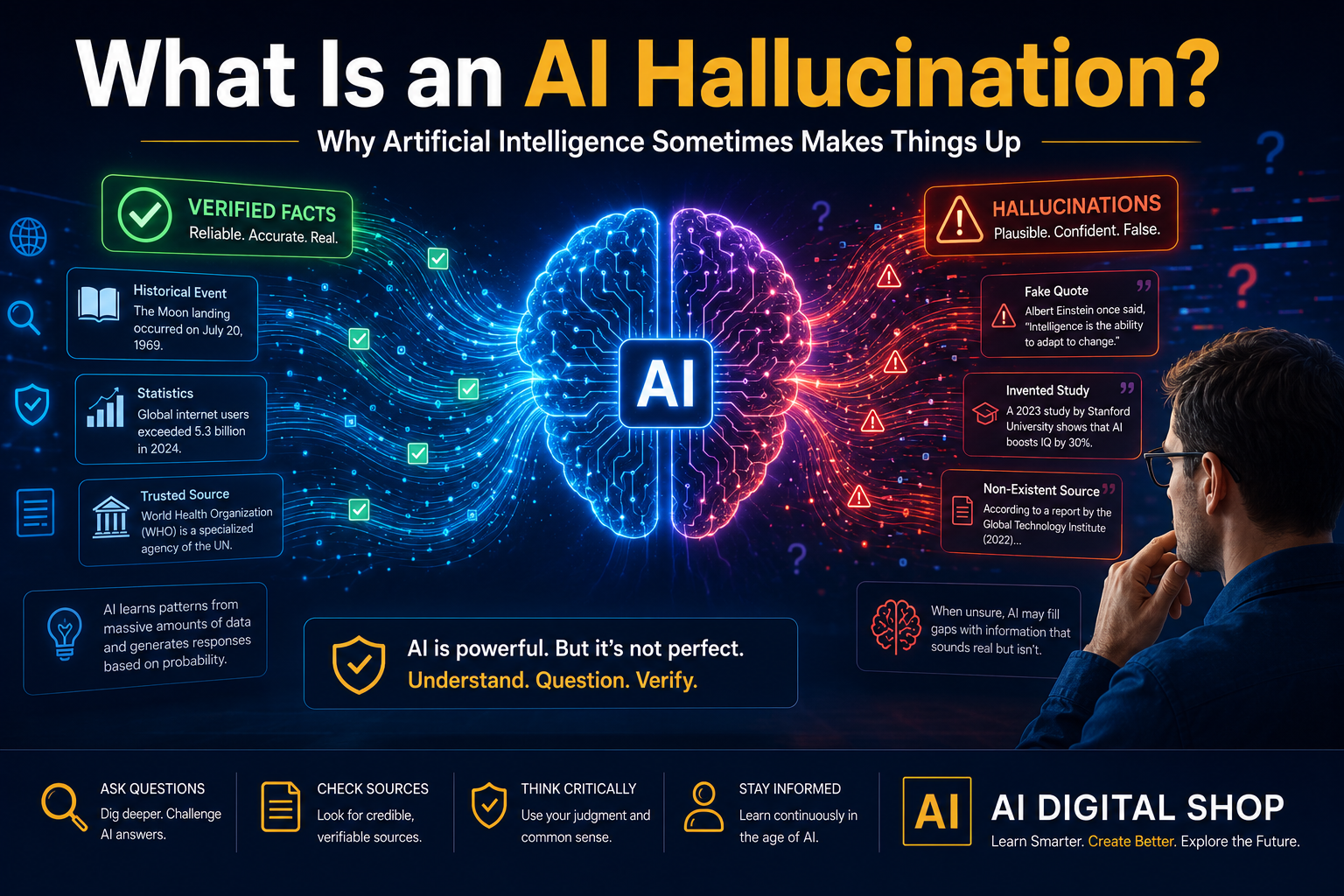
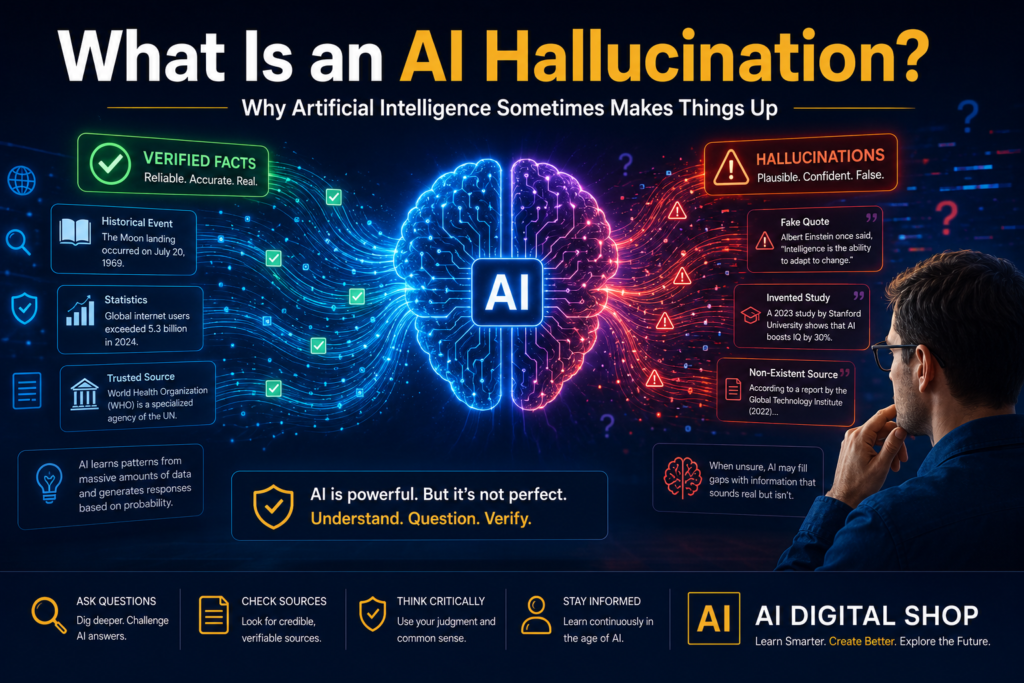
An AI hallucination occurs when an AI system generates information that appears believable but is incorrect, misleading, or entirely fabricated.
Examples include:
- Invented facts
- Fake quotations
- Non-existent sources
- Incorrect statistics
- Imaginary research studies
- Fabricated historical events
- False references
The challenge is that these answers often sound completely convincing.
In many cases, an AI hallucination can look almost identical to a correct answer.
Why Are They Called Hallucinations?
The term “hallucination” is used because the AI produces information that does not exist in reality.
Just as a human hallucination involves perceiving something that is not actually present, an AI hallucination involves generating information that is not actually true.
The AI is not intentionally lying.
It simply produces an answer that appears plausible based on patterns in its training data.
A Simple Example
Imagine asking an AI:
“Who won the Nobel Prize for Artificial Intelligence in 2018?”
The AI might confidently provide:
- A winner’s name
- A detailed biography
- An explanation of their achievement
The problem?
There is no Nobel Prize for Artificial Intelligence.
The AI may generate an answer anyway because it is attempting to satisfy the request rather than recognizing the false assumption behind the question.
Why Do AI Hallucinations Happen?
To understand hallucinations, it helps to understand how AI works.
AI systems do not think like humans.
They do not possess personal knowledge, beliefs, or understanding.
Instead, they analyze patterns in enormous amounts of data.
When you ask a question, the AI predicts what sequence of words is most likely to come next.
Most of the time, this works remarkably well.
Sometimes it does not.
When information is uncertain, incomplete, or unavailable, the AI may still attempt to generate a response.
That is when hallucinations become more likely.
Common Causes of AI Hallucinations
Missing Information
The AI may not have enough reliable information available.
Ambiguous Questions
Vague prompts often increase the likelihood of inaccurate answers.
Complex Topics
The more complicated a subject becomes, the greater the opportunity for mistakes.
Invented Sources
Sometimes AI systems generate references that look real but do not actually exist.
Outdated Information
Technology, laws, prices, and current events change rapidly.
Older information may no longer be accurate.
Real-World Examples
AI hallucinations can include:
Fake Books
The AI invents a book title that was never published.
Fake Court Cases
The AI cites legal cases that never existed.
Fake Statistics
The AI generates numbers without reliable evidence.
Fake Academic Studies
The AI references research papers that cannot be found.
Fake Quotes
The AI attributes statements to people who never said them.
Are Hallucinations Dangerous?
They can be.
The level of risk depends on how the information is being used.
For example:
Low Risk
- Brainstorming blog ideas
- Generating story concepts
- Creative writing
A mistake may have little consequence.
High Risk
- Medical decisions
- Legal advice
- Financial planning
- Scientific research
In these situations, verification becomes essential.
How Often Do Hallucinations Occur?
The frequency varies depending on:
- The AI model
- The complexity of the question
- The available information
- The quality of the prompt
Modern AI systems are becoming more accurate every year.
However, no current system is completely free from hallucinations.
How to Spot an AI Hallucination
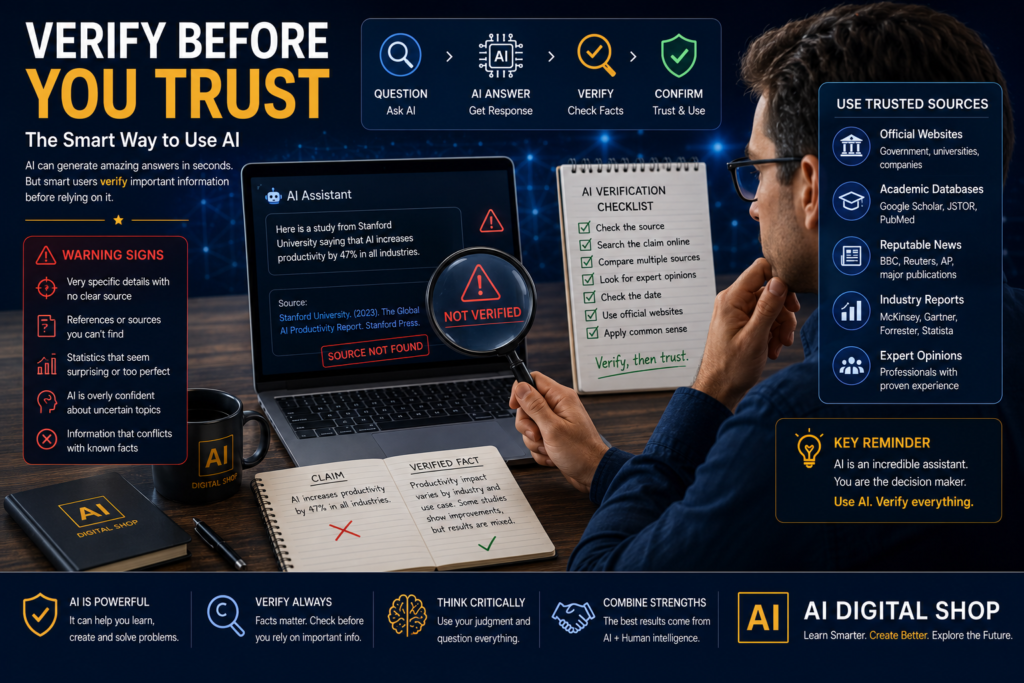
Certain warning signs should trigger caution.
Extremely Specific Claims
Especially when no source is provided.
Invented References
If a source cannot be located independently, investigate further.
Overconfidence
AI often presents incorrect information with the same confidence as correct information.
Surprising Facts
Extraordinary claims deserve additional verification.
How to Reduce Hallucinations
You can significantly improve results by:
Asking Better Questions
Specific prompts generally produce better answers.
Requesting Sources
Ask where the information originated.
Breaking Large Questions Into Smaller Questions
Smaller topics are often easier to verify.
Cross-Checking Information
Compare answers with reputable sources.
Following Up
Ask the AI to explain its reasoning.
The Human Advantage
Artificial intelligence is powerful.
But humans still possess important strengths.
Humans provide:
- Judgment
- Context
- Experience
- Critical thinking
- Skepticism
The best results occur when AI and human intelligence work together.
Will Hallucinations Disappear?
AI systems continue improving.
Future models will likely become:
- More accurate
- Better at reasoning
- More reliable
- Better at citing sources
However, complete elimination of hallucinations may remain difficult.
Human oversight will likely remain important for years to come.
Final Thoughts
AI hallucinations are not evidence that artificial intelligence is useless.
They are evidence that AI is not perfect.
The smartest users understand both the strengths and limitations of AI systems.
By learning how hallucinations occur and how to verify information, you can use artificial intelligence more confidently and effectively.
Key Takeaways
✅ AI hallucinations are false or fabricated information generated by AI.
✅ Hallucinations often sound convincing.
✅ AI is not intentionally lying.
✅ Verification is essential for important decisions.
✅ Human judgment remains critical.
✅ Understanding hallucinations makes you a better AI user.
Related Articles
- Can You Trust AI Answers?
- How to Fact-Check AI Responses
- Why AI Invents Sources
- AI vs Search Engines
- Common AI Mistakes Beginners Make
Learn Smarter. Create Better. Explore the Future.
📚 About the Publisher
Solvberg Publishing creates practical resources that help entrepreneurs, creators, educators, and lifelong learners succeed in the digital age.
Our growing library includes AI guides, business resources, children’s books, digital publishing tools, and educational content designed to inform, inspire, and empower.
Whether you’re building an online business, exploring artificial intelligence, or discovering new stories with your family, our goal is simple:
Create content that makes a difference.