
Can AI Be Trusted for Financial Advice?
What Investors, Savers, and Beginners Need to Know
Introduction
Artificial intelligence is increasingly being used to answer financial questions.
People ask AI about:
- Investing
- Saving money
- Budgeting
- Retirement planning
- Taxes
- Stocks
- Cryptocurrency
The appeal is obvious.
AI can explain complex financial topics in seconds.
But an important question remains:
Can AI actually be trusted for financial advice?
The answer is similar to healthcare:
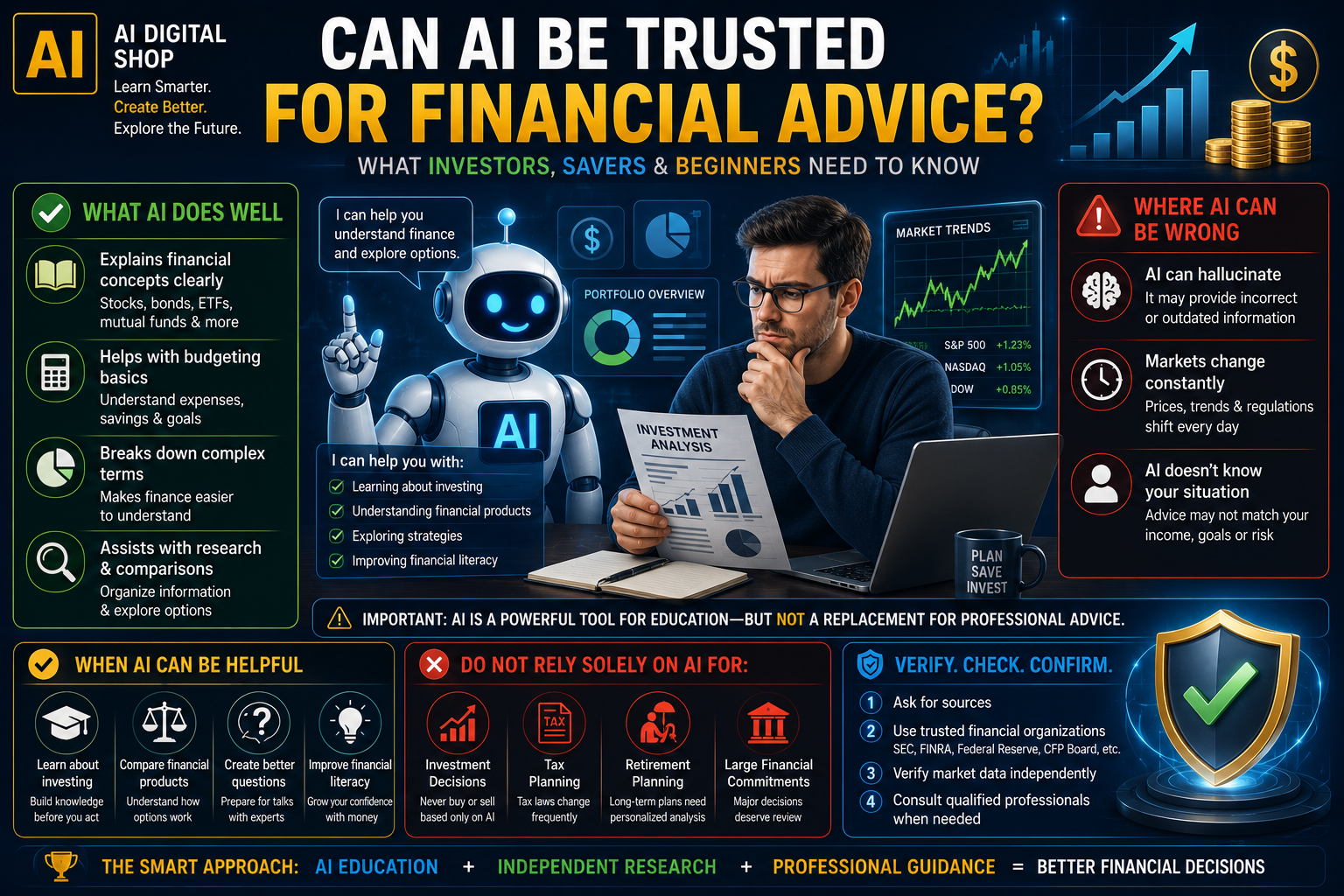
AI can be a powerful educational tool.
It should not replace qualified financial professionals or your own research.
What AI Does Well
AI can often provide useful assistance with:
Financial Education
Explaining concepts such as:
- Stocks
- Bonds
- ETFs
- Mutual funds
- Retirement accounts
Budgeting Basics
Helping users understand:
- Expenses
- Savings goals
- Spending habits
Investment Terminology
Breaking down complicated financial language into plain English.
Research Assistance
Helping organize information and compare financial concepts.
Where AI Can Be Wrong
AI has limitations that become important when money is involved.
AI Can Hallucinate
AI may occasionally provide:
- Incorrect figures
- Outdated regulations
- Inaccurate tax information
- False assumptions
Markets Change Constantly
Financial markets move every day.
Prices, regulations, and economic conditions change rapidly.
AI may not always have the latest information.
AI Doesn’t Know Your Situation
Financial decisions depend on:
- Income
- Debt
- Risk tolerance
- Goals
- Family circumstances
Generic advice may not fit your needs.
When AI Can Be Helpful
Low-risk uses include:
Learning About Investing
Understanding concepts before making decisions.
Comparing Financial Products
Learning how different options work.
Creating Questions
Preparing questions for financial professionals.
Improving Financial Literacy
Building knowledge and confidence.
When You Should Not Rely Solely on AI
Avoid using AI as your only source for:
Investment Decisions
Never buy or sell solely because AI suggests it.
Tax Planning
Tax laws can be complex and change frequently.
Retirement Planning
Long-term decisions require personalized analysis.
Large Financial Commitments
Major investments deserve professional review.
Red Flags to Watch For
Be cautious if AI:
⚠️ Guarantees profits
⚠️ Predicts exact market outcomes
⚠️ Claims risk-free returns
⚠️ Provides no sources
⚠️ Sounds overly confident
How to Verify Financial Information
Step 1
Ask for sources.
Step 2
Use official financial organizations.
Step 3
Verify market data independently.
Step 4
Consult qualified professionals when necessary.
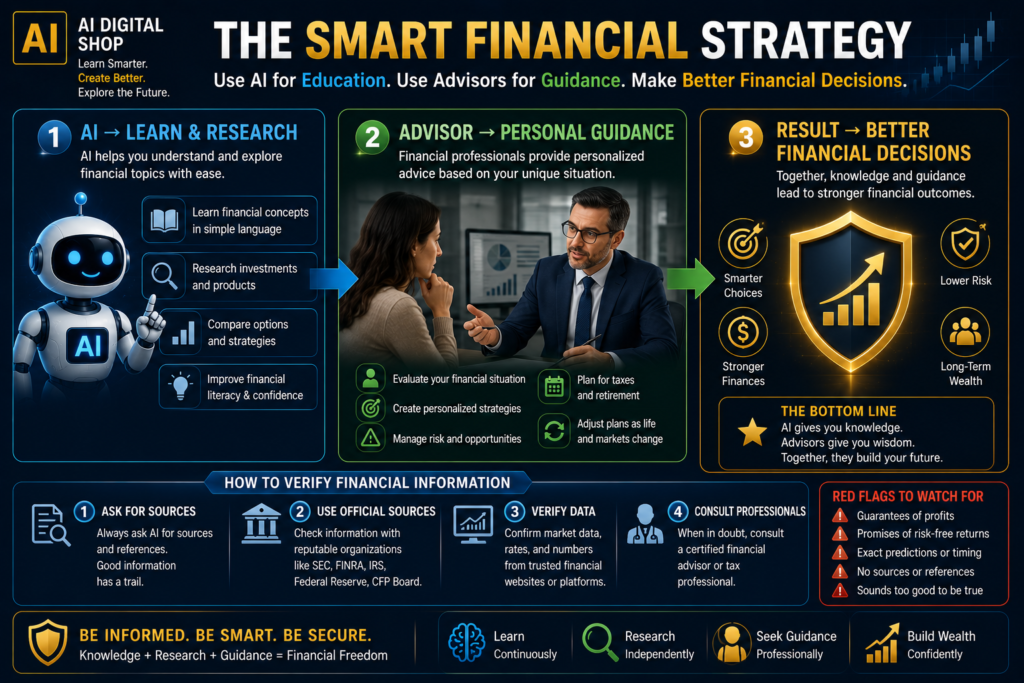
The Smart Financial Strategy
Think of AI as:
A Financial Education Assistant
Not:
A Personal Financial Advisor
This mindset helps reduce mistakes.
The Future of AI and Finance
Artificial intelligence is already being used for:
- Market analysis
- Fraud detection
- Customer service
- Portfolio management
- Financial research
Future systems will likely become more sophisticated.
Human judgment will still matter.
Final Verdict
Can AI be trusted for financial advice?
Yes—for education.
No, for major financial decisions without verification.
AI can help you understand money.
Only you—and qualified professionals—should make financial decisions.
The smartest approach combines:
- AI education
- Independent research
- Professional guidance
Key Takeaways
1. AI can explain financial concepts.
2. AI can improve financial literacy.
3. AI can make mistakes.
4. Markets change rapidly.
5. Verification remains essential.
6. Human judgment still matters.
Related Articles
- Can You Trust AI Answers?
- How to Fact-Check AI Answers
- Why AI Invents Sources
- AI vs Google Search
- Can AI Be Trusted for Medical Information?
Learn Smarter. Create Better. Explore the Future.
📚 About the Publisher
Solvberg Publishing creates practical resources that help entrepreneurs, creators, educators, and lifelong learners succeed in the digital age.
Our growing library includes AI guides, business resources, children’s books, digital publishing tools, and educational content designed to inform, inspire, and empower.
Whether you’re building an online business, exploring artificial intelligence, or discovering new stories with your family, our goal is simple:
Create content that makes a difference.