
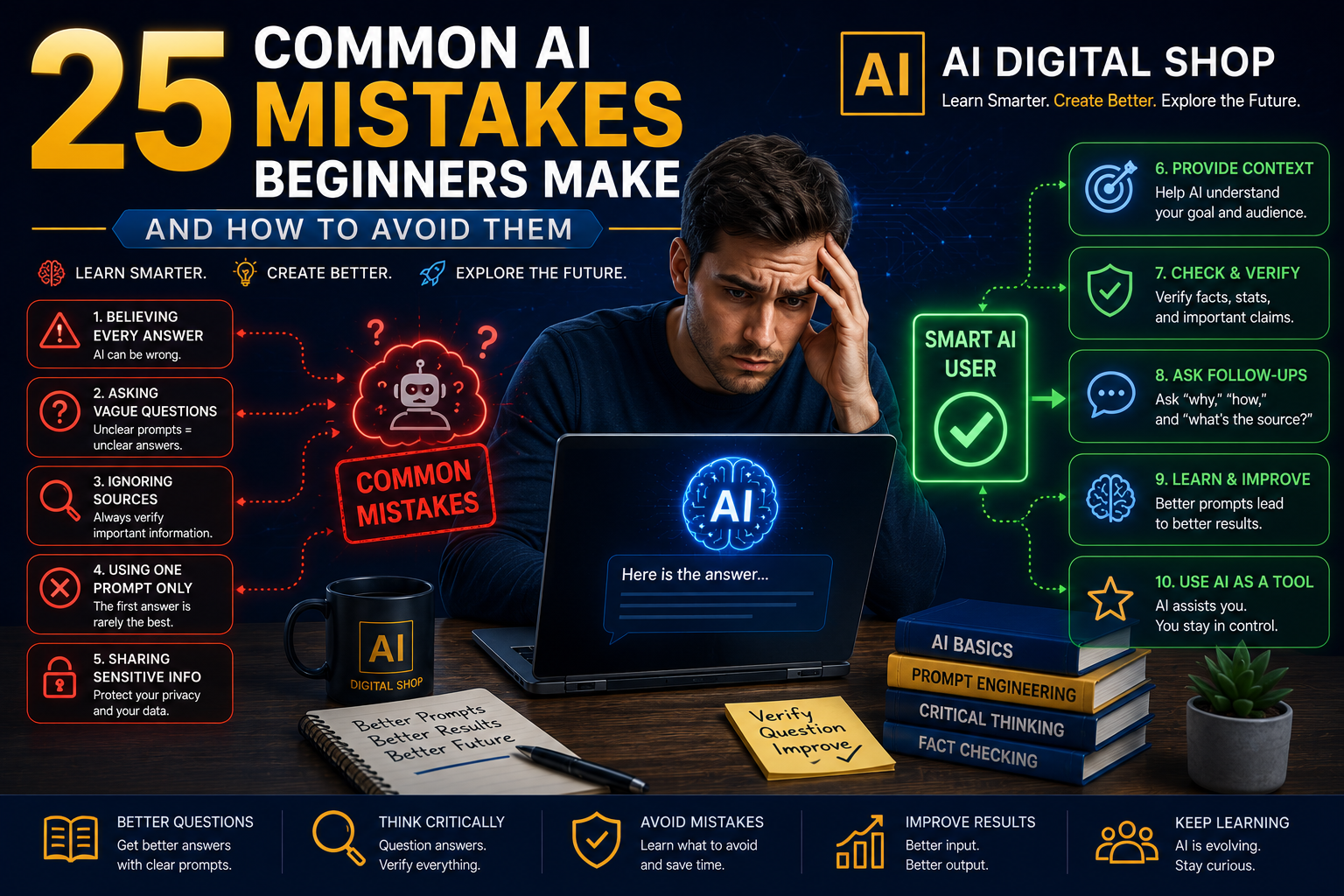
25 Common AI Mistakes Beginners Make
And How to Avoid Them
Introduction
Artificial intelligence can be one of the most powerful tools available today.
It can help you:
- Learn faster
- Save time
- Generate ideas
- Create content
- Improve productivity
However, many new users unintentionally make mistakes that limit the quality of their results.
The good news?
Most AI mistakes are easy to avoid once you understand them.
Let’s look at the most common ones.
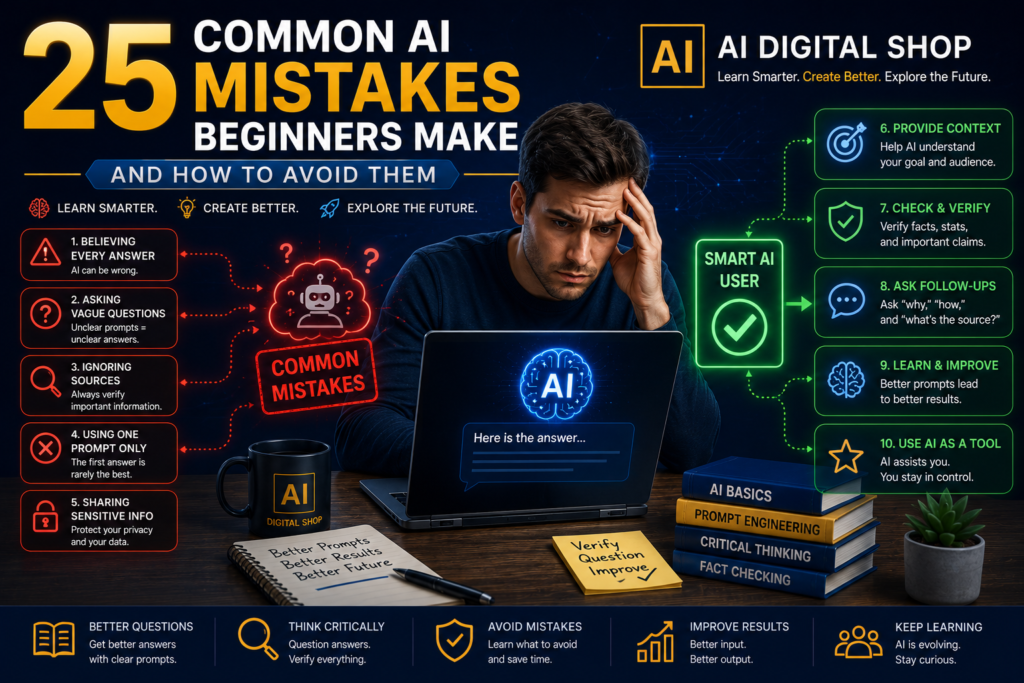
Mistake #1
Believing Every AI Answer
AI can be wrong.
Always verify important information.
Mistake #2
Asking Vague Questions
Bad:
“Tell me about marketing.”
Better:
“Explain beginner email marketing strategies for a small online store.”
Specific questions produce better answers.
Mistake #3
Treating AI Like Google
AI is not a search engine.
It generates responses.
Search engines retrieve information.
Understanding the difference matters.
Mistake #4
Ignoring Sources
Whenever possible:
- Ask for sources
- Verify claims
- Cross-check information
Mistake #5
Using One Prompt Only
The first answer is rarely the best answer.
Refine.
Experiment.
Ask follow-up questions.
Mistake #6
Not Providing Context
AI performs better when it understands:
- Your goal
- Your audience
- Your experience level
Mistake #7
Expecting Perfection
AI is powerful.
AI is not perfect.
Mistake #8
Sharing Sensitive Information
Never share:
- Passwords
- Banking information
- Confidential business information
Protect your privacy.
Mistake #9
Ignoring Hallucinations
AI sometimes invents facts, sources, and statistics.
Verification matters.
Mistake #10
Using AI for High-Stakes Decisions Alone
Never rely solely on AI for:
- Legal matters
- Medical issues
- Financial decisions
Professional advice remains important.
Mistake #11
Asking Multiple Questions at Once
Large prompts can confuse the conversation.
Break complex tasks into smaller steps.
Mistake #12
Failing to Challenge AI
Ask:
- Why?
- How?
- What’s the evidence?
Good user questions.
Mistake #13
Not Learning Prompt Engineering
Prompt quality often determines output quality.
Learning prompting is one of the highest-value AI skills.
Mistake #14
Assuming AI Understands Everything
AI predicts language patterns.
It does not possess human understanding.
Mistake #15
Forgetting That Information Changes
Technology evolves.
Laws change.
Prices change.
Current information should be verified.
Mistake #16
Using AI Without a Goal
Before opening AI:
Ask yourself:
“What am I trying to accomplish?”
Mistake #17
Ignoring Alternative Perspectives
Request multiple viewpoints.
You’ll often receive more balanced insights.
Mistake #18
Accepting the First Draft
AI drafts are starting points.
Editing improves results.
Mistake #19
Expecting AI to Replace Learning
AI supports learning.
It does not replace learning.
Mistake #20
Overusing Automation
Human oversight remains valuable.
Especially for important work.
Mistake #21
Not Fact-Checking Statistics
Statistics are common hallucination targets.
Always verify numerical claims.
Mistake #22
Using Poor Follow-Up Questions
The conversation improves when follow-ups become more specific.
Mistake #23
Ignoring AI Limitations
Every technology has strengths and weaknesses.
AI is no exception.
Mistake #24
Comparing Yourself to Experts
Everyone starts somewhere.
Experimenting is part of the learning process.
Mistake #25
Stopping Too Soon
The best AI users continuously:
- Learn
- Test
- Experiment
- Improve
The Good News
Most AI mistakes are easy to avoid.
The more experience you gain, the better your prompts, results, and understanding become.
AI rewards curiosity.
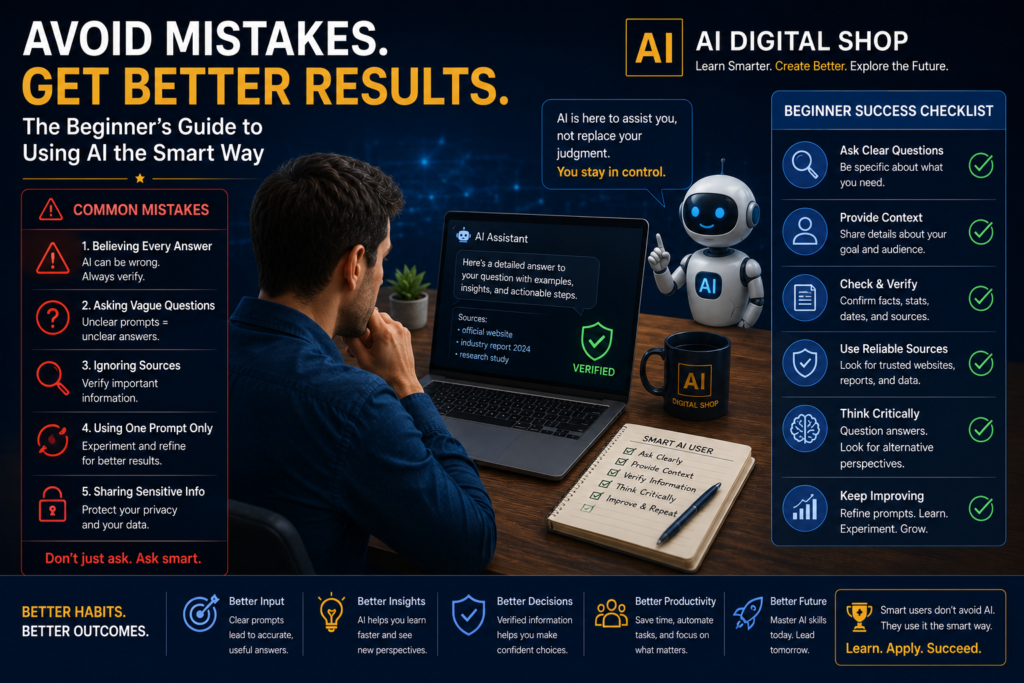
Beginner Success Checklist
Before trusting an AI answer:
✅ Ask clear questions
✅ Verify important facts
✅ Request sources
✅ Use critical thinking
✅ Protect private information
✅ Continue learning
Final Thoughts
Artificial intelligence is one of the most exciting technologies available today.
People who learn to use it effectively will often gain significant advantages in productivity, learning, creativity, and business.
Avoiding these common mistakes is one of the fastest ways to improve your results.
Related Articles
- Can You Trust AI Answers?
- What Is an AI Hallucination?
- How to Fact-Check AI Responses
- AI Prompting Basics
- AI vs Search Engines
Learn Smarter. Create Better. Explore the Future.
📚 About the Publisher
Solvberg Publishing creates practical resources that help entrepreneurs, creators, educators, and lifelong learners succeed in the digital age.
Our growing library includes AI guides, business resources, children’s books, digital publishing tools, and educational content designed to inform, inspire, and empower.
Whether you’re building an online business, exploring artificial intelligence, or discovering new stories with your family, our goal is simple:
Create content that makes a difference.