
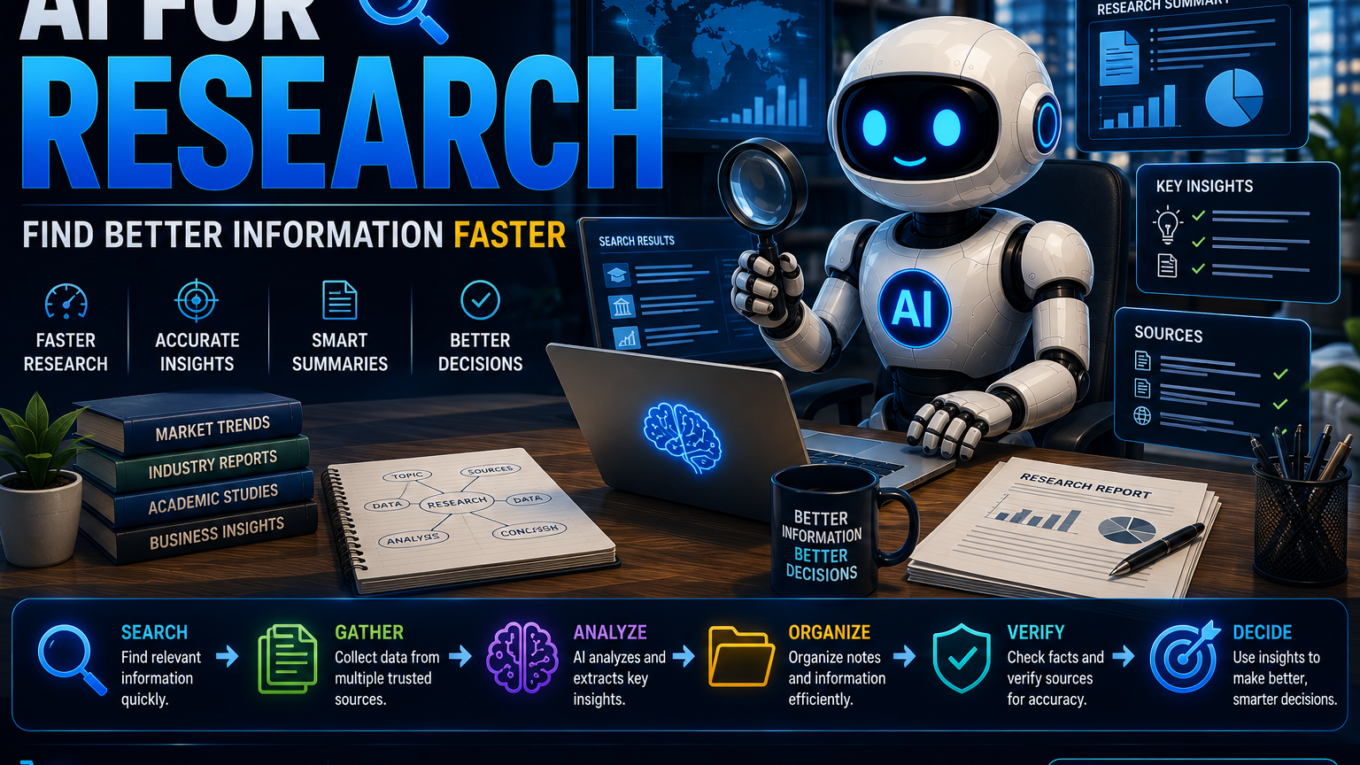
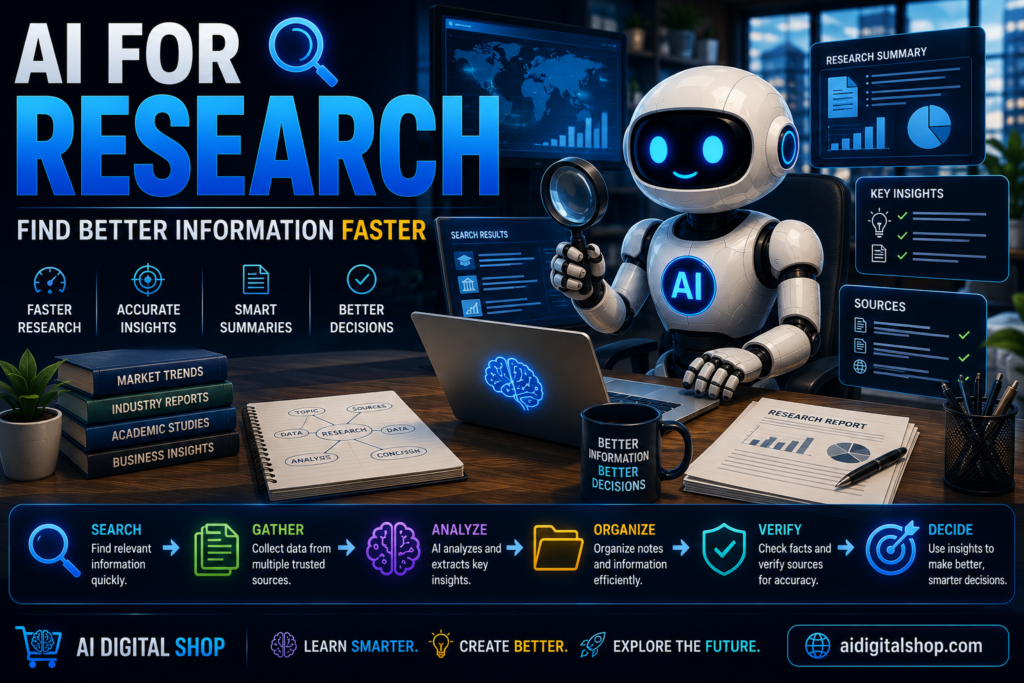
AI for Research: Find Better Information Faster
Introduction
Research is one of the most time-consuming tasks in modern life.
Whether you’re a student writing a paper, a professional preparing a report, a business owner analyzing competitors, or simply someone trying to learn something new, finding accurate information takes time.
Artificial intelligence is changing that.
Today’s AI tools can help users locate information, summarize content, organize findings, and identify key insights faster than ever before.
The goal is not to replace human thinking.
The goal is to help people spend less time searching and more time understanding.
Used correctly, AI can become one of the most powerful research assistants ever created.
Why Research Often Feels Overwhelming
The internet contains an incredible amount of information.
The challenge isn’t finding information.
The challenge is finding the right information.
Many researchers struggle with:
- Information overload
- Conflicting sources
- Time-consuming searches
- Organizing findings
- Identifying reliable information
AI helps reduce these challenges by filtering, summarizing, and organizing information more efficiently.
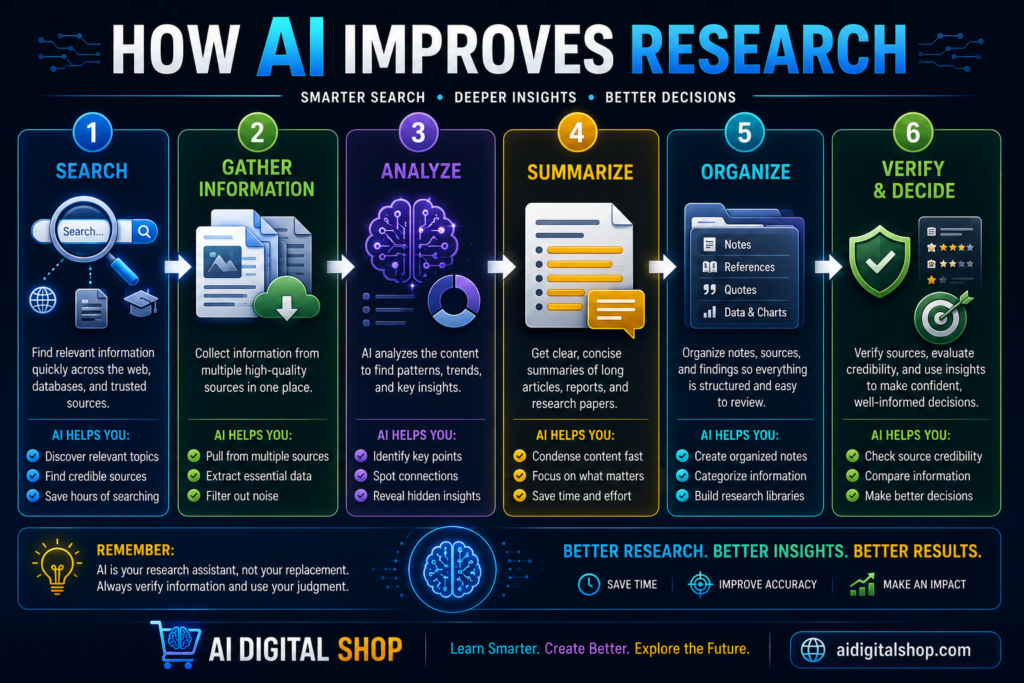
How AI Speeds Up Research
AI can dramatically reduce the time needed to gather information.
Instead of reading dozens of articles from start to finish, AI can help identify the most relevant sections.
Benefits include:
Faster Information Gathering
Better Organization
Quick Summaries
Key Insight Extraction
Research Question Generation
The result is a more efficient research process.
Summarizing Large Amounts of Information
One of AI’s greatest strengths is summarization.
Researchers can use AI to:
- Summarize articles
- Condense reports
- Review studies
- Extract key findings
- Highlight important points
This saves time while helping users focus on the most relevant information.
Comparing Multiple Sources
Good research rarely relies on a single source.
AI can help compare:
Different Viewpoints
Conflicting Opinions
Market Trends
Product Features
Industry Reports
Comparing information becomes faster and more manageable.
Organizing Research Notes
Collecting information is only part of the process.
Organization is equally important.
AI can help:
- Create outlines
- Categorize findings
- Build summaries
- Organize references
- Structure reports
This makes large research projects easier to manage.
Generating Better Research Questions
Sometimes the hardest part of research is knowing what to ask.
AI can assist by suggesting:
Follow-Up Questions
Alternative Perspectives
Related Topics
Missing Information
Strong questions often lead to stronger research outcomes.
Best AI Tools for Research
Several AI tools are particularly useful for research.
ChatGPT
Excellent for brainstorming, summaries, and exploring ideas.
Perplexity
Provides research-focused answers and source references.
Google Gemini
Strong for information gathering and comparison.
Claude
Excellent for working with large documents and detailed analysis.
Notion AI
Useful for organizing notes and research projects.
Each tool has strengths and weaknesses, so many researchers use several together.
AI for Students
Students can use AI to:
- Understand difficult concepts
- Summarize chapters
- Create study guides
- Generate practice questions
- Organize assignments
AI helps learners focus on understanding rather than information management.
AI for Professionals
Professionals often research:
- Industry trends
- Competitors
- Market opportunities
- Customer needs
- New technologies
AI can help speed up these activities while improving efficiency.
AI for Small Business Owners
Business owners frequently need information about:
Marketing
Competitors
Products
Customers
Industry Trends
AI helps gather and organize this information quickly.
Common Research Mistakes to Avoid
While AI is powerful, mistakes still happen.
Avoid:
Trusting AI Without Verification
Using Only One Source
Ignoring Expert Opinions
Accepting AI Answers as Facts
Skipping Original Sources
The best researchers use AI as an assistant, not as the final authority.
How to Verify AI Research
Verification remains essential.
Best practices include:
Check Original Sources
Compare Multiple Sources
Verify Statistics
Look for Expert Consensus
Use Trusted Publications
This is especially important when researching topics involving health, finance, law, or major business decisions.
The Future of AI-Powered Research
Research tools continue to improve.
Future AI systems may provide:
- More accurate summaries
- Better source verification
- Personalized research assistants
- Advanced document analysis
- Real-time knowledge updates
These developments could dramatically improve how people gather and use information.
Final Thoughts
Artificial intelligence is becoming one of the most valuable research tools available today.
Used wisely, AI can help you:
- Find information faster
- Organize research efficiently
- Compare multiple sources
- Generate better questions
- Save significant amounts of time
The future of research is not about replacing human curiosity.
It is about giving curious people better tools.
The most successful researchers will combine AI efficiency with critical thinking, verification, and sound judgment.
Key Takeaways
1. AI speeds up information gathering.
2. AI helps summarize and organize research.
3. AI improves productivity for students and professionals.
4. Verification remains essential.
5. Multiple sources produce stronger results.
6. AI works best when combined with human judgment.
Related Articles
- AI for Everyday Life
- AI for Learning: Study Smarter, Not Harder
- AI for Work: Work Smarter, Not Harder
- Can You Trust AI Answers?
- Why AI Invents Sources?
- How AI Learns
Learn Smarter. Create Better. Explore the Future.
📚 About the Publisher
Solvberg Publishing creates practical resources that help entrepreneurs, creators, educators, and lifelong learners succeed in the digital age.
Our growing library includes AI guides, business resources, children’s books, digital publishing tools, and educational content designed to inform, inspire, and empower.
Whether you’re building an online business, exploring artificial intelligence, or discovering new stories with your family, our goal is simple:
Create content that makes a difference.